Differentials of inverse circular functions
We now turn to the inverse circular functions — arcsin, arccos, arctan, arcsec, arccosec, and arccot — and find their differentials using implicit differentiation.
Take your time with each video. Pause, rewind, and think before moving on!
 Dr Brian Brooks
Mathematics InSight
If \(\displaystyle{y=\arcsin x}\), what is \(\displaystyle{\frac{\mathrm{d}x}{\mathrm{d}y}}\) in terms of \(\displaystyle{y}\) ?
What is \(\displaystyle{\cos y}\) in terms of \(x\) ?
Is \(\displaystyle{\cos y}\) positive or negative when \(y=\arcsin x\)?
What are \(\displaystyle{\frac{\mathrm{d}x}{\mathrm{d}y}\text{ and }\frac{\mathrm{d}y}{\mathrm{d}x}}\) in terms of \(\displaystyle{x}\) ?
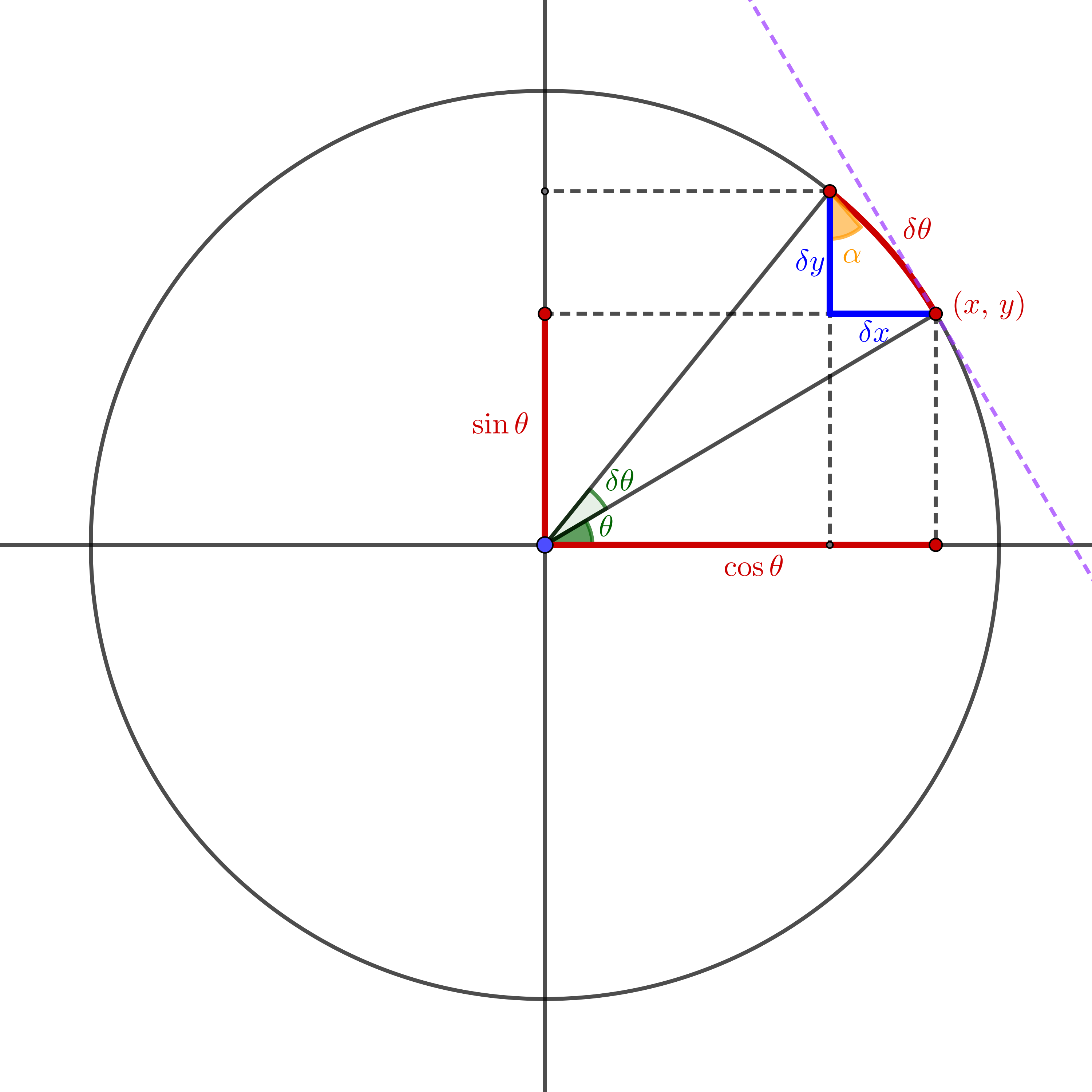
Although I know that the circular functions are, rather obviously, related to circles, I was still intrigued by the fact that the differentials of the inverse functions look so much like the equation of a circle.
To satisfy my curiosity, I went back to a diagram from earlier in the Differentials Extra sheet. Here is a summary of my thinking — it's not a detailed walk-through, more of an expository excursion.
First, notice that \(\delta x < 0\), even though it is attached in the diagram to a positive distance.
Well done!
You've now found the differentials of all six inverse circular functions: arcsin, arccos, arctan, arcsec, arccosec, and arccot.
Dr Brian Brooks
Mathematics InSight