Welcome to the definitions stage of your circular functions journey
In this stage we establish the key standard values of sin, cos, and tan, and use the unit circle to extend these functions to all real numbers — including angles beyond 360° and negative angles.
Take your time with each page. Work on the questions before moving to the answers!
 Dr Brian Brooks
Mathematics InSight
Use this diagram to find sin, cos, and tan of \(60°\) and \(30°\).
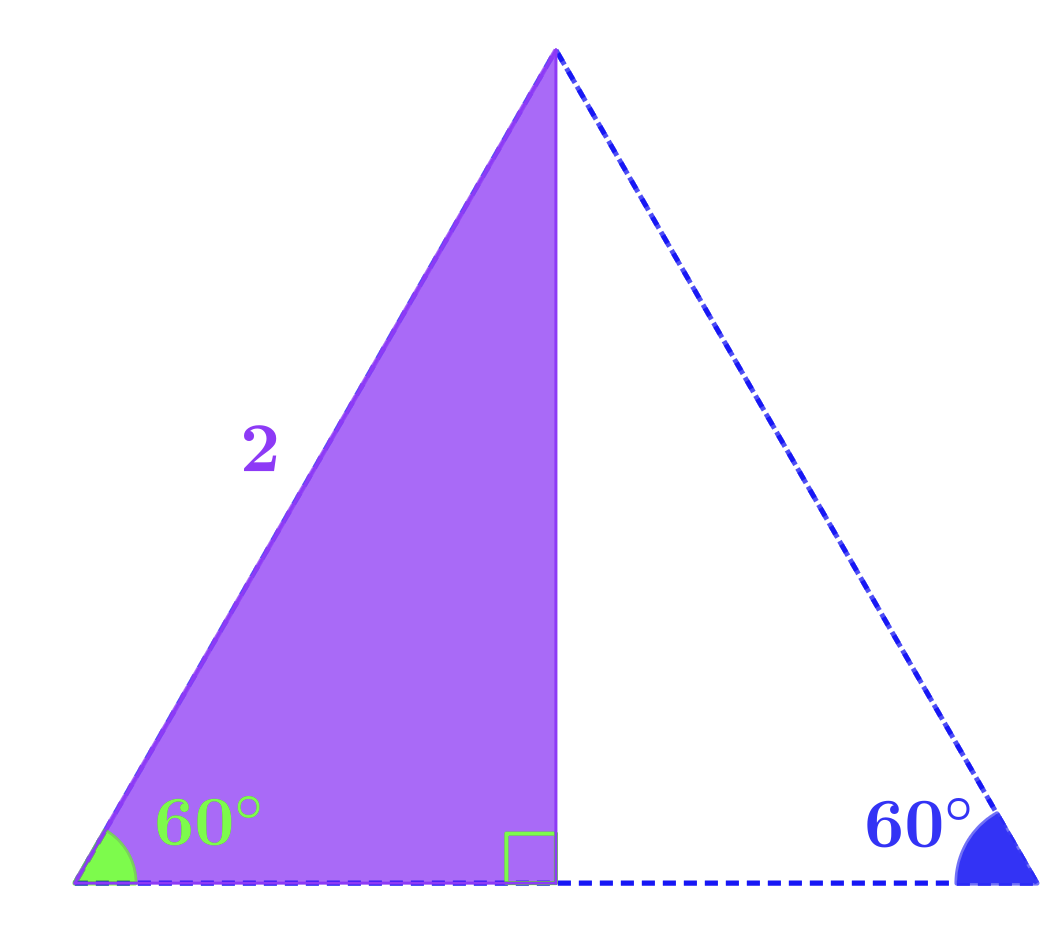
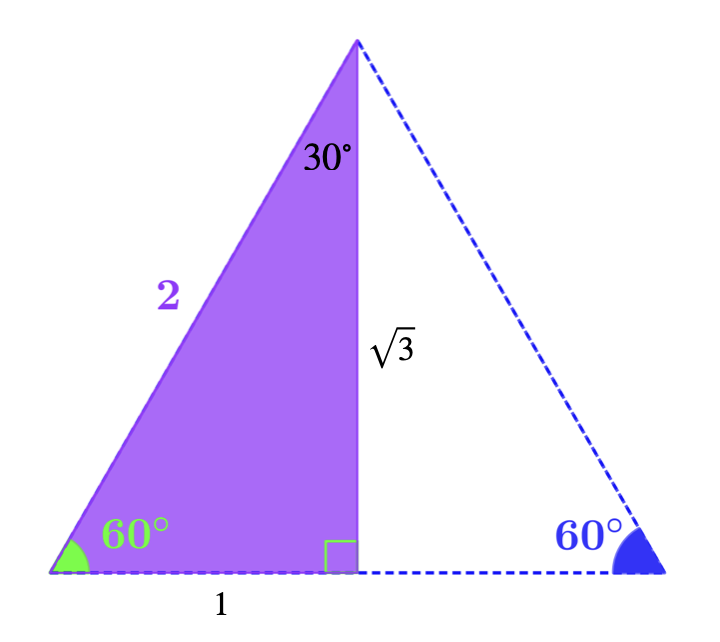
The big triangle is equilateral, so the base of the shaded triangle is half the length of the side of the big triangle. Then Pythagoras gives the height \(\sqrt{3}\) :
| \(\cos 60° = \dfrac{1}{2}\) | \(\sin 60° = \dfrac{\sqrt{3}}{2}\) | \(\tan 60° = \sqrt{3}\) |
| \(\sin 30° = \dfrac{1}{2}\) | \(\cos 30° = \dfrac{\sqrt{3}}{2}\) | \(\tan 30° = \dfrac{1}{\sqrt{3}} = \dfrac{\sqrt{3}}{3}\) |
Use this diagram to find sin, cos, and tan of \(45°\).
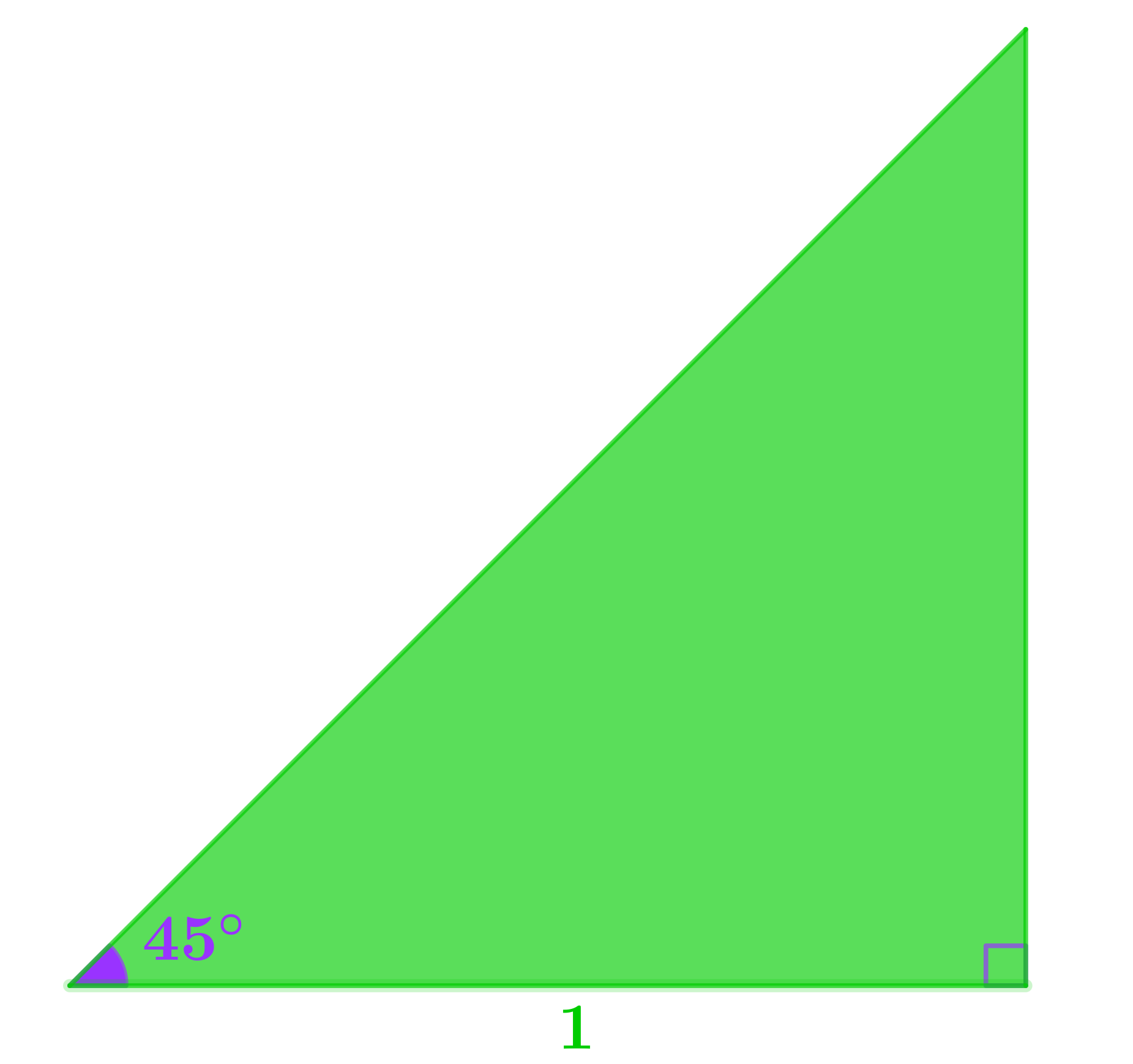
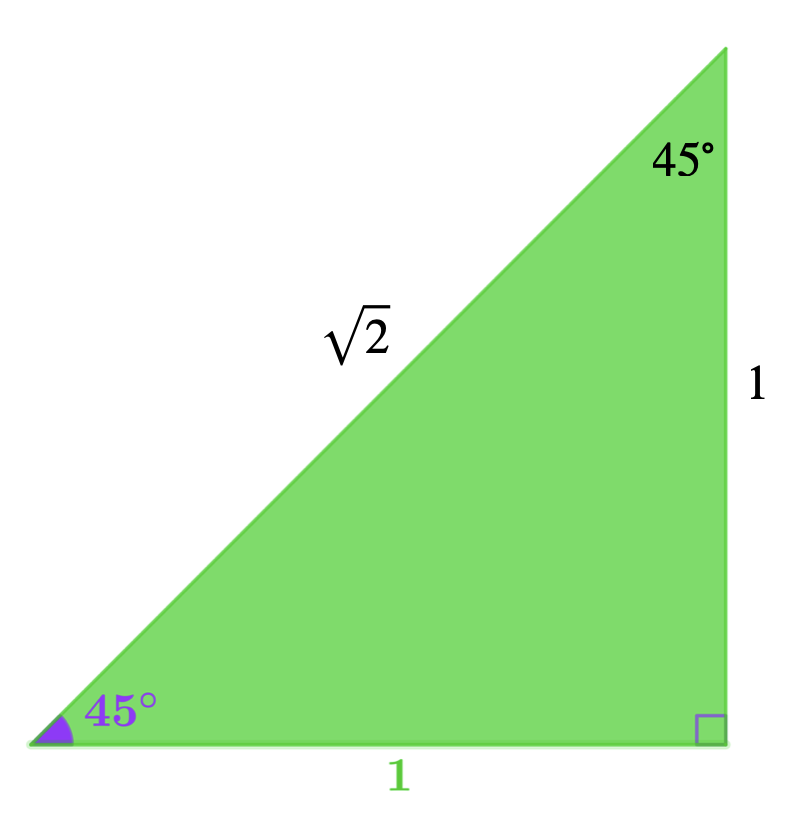
| \(\cos 45° = \dfrac{1}{\sqrt{2}} = \dfrac{\sqrt{2}}{2}\) | \(\sin 45° = \dfrac{1}{\sqrt{2}} = \dfrac{\sqrt{2}}{2}\) | \(\tan 45° = 1\) |
Now we know the standard values of sin, cos, and tan of \(30^\circ,\;60^\circ,\;\text{and }45^\circ\), and we will use these over and over on the rest of this journey.
Next, we are ready to see how right-angled triangles relate to the coordinates of points on a circle radius \(1\) with centre at the origin.
In this diagram, what are the coordinates of the pink point and the gradient of the pink radius?
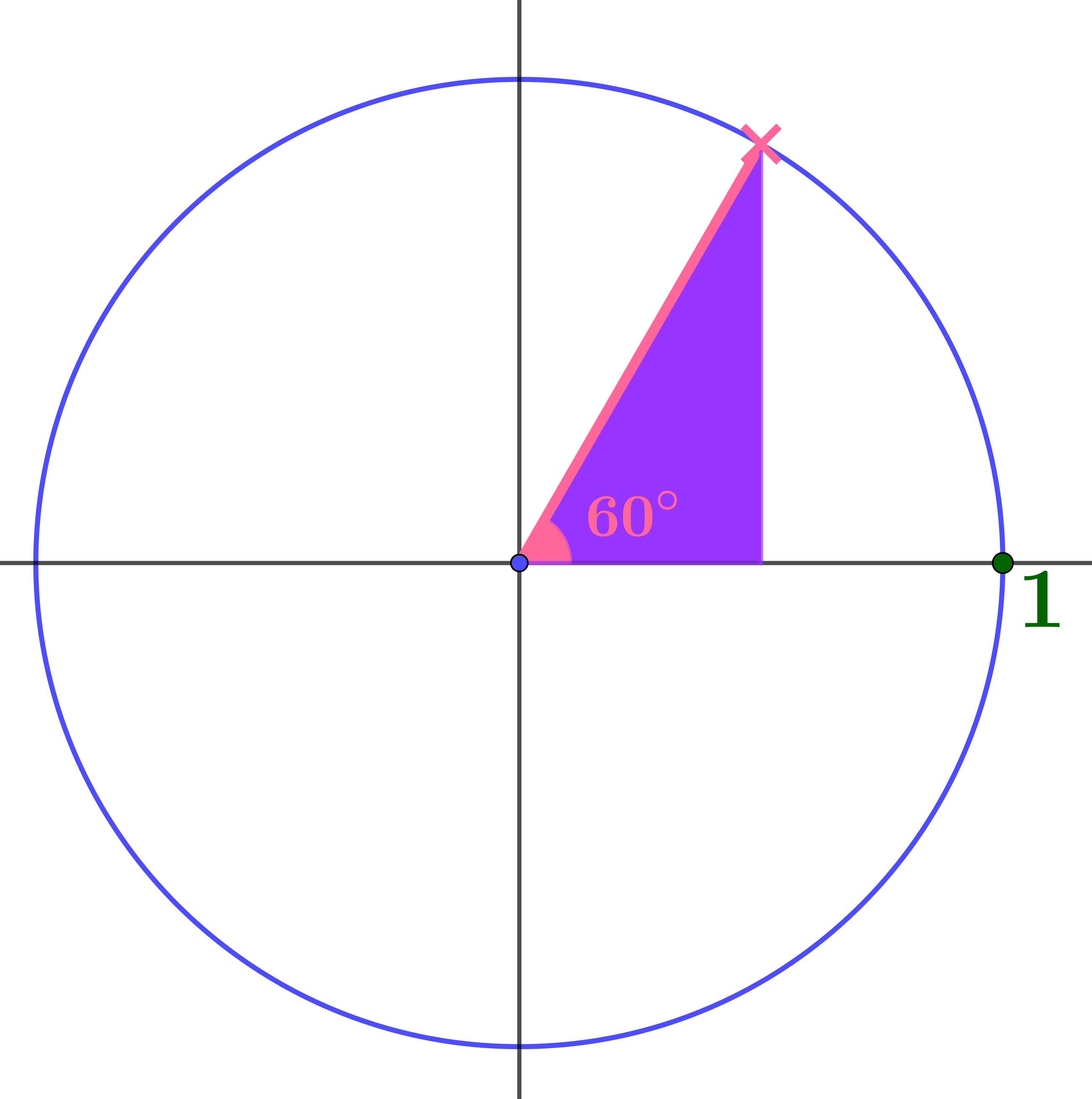
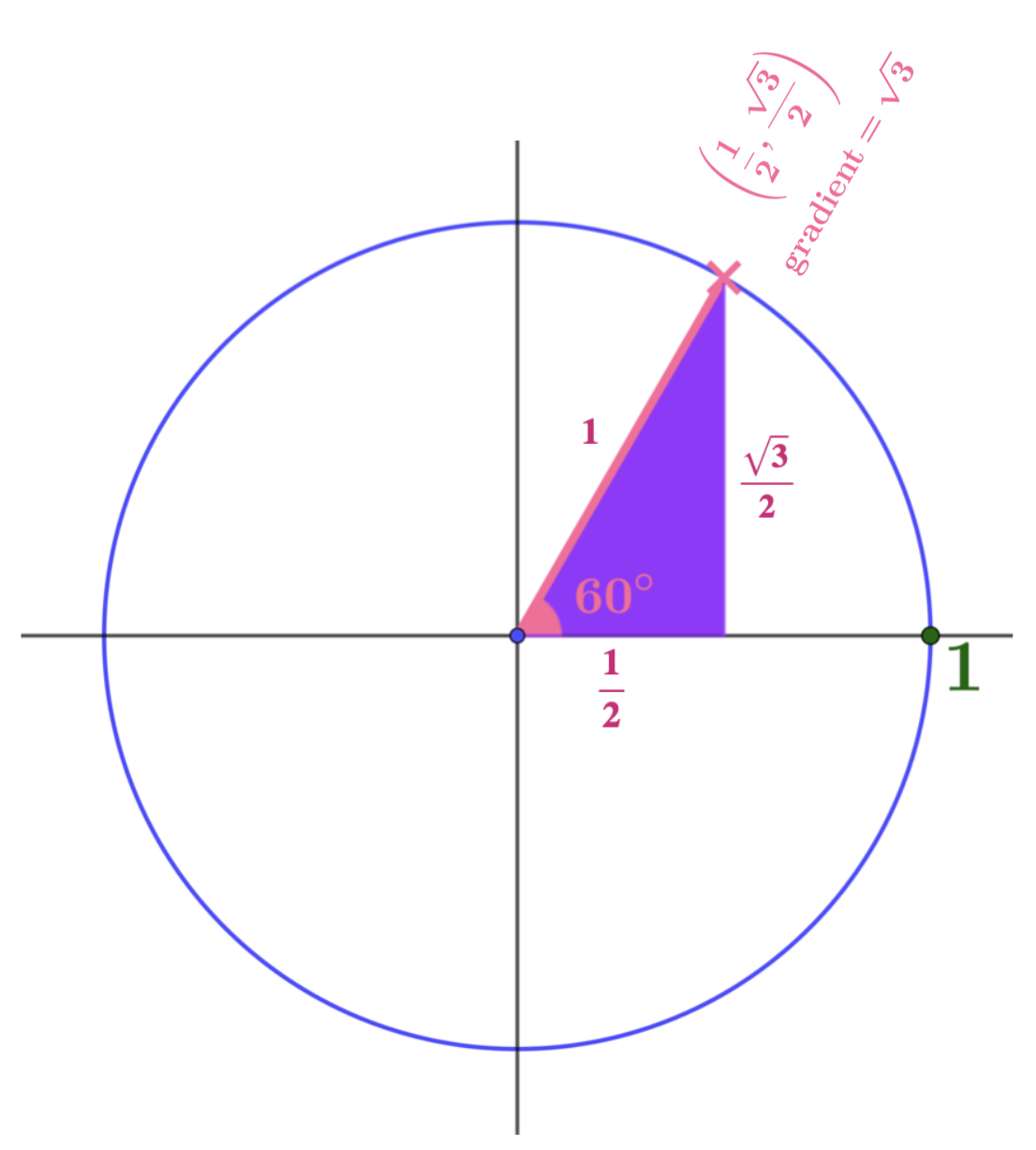
We know the base and the height of the triangle are cos and sin of \(60^\circ\) and these give us the coordinates of the pink point right away. The gradient is the height over the width, which is also \(\tan 60^\circ\).
What are the coordinates of the green point and the gradient of the green radius?
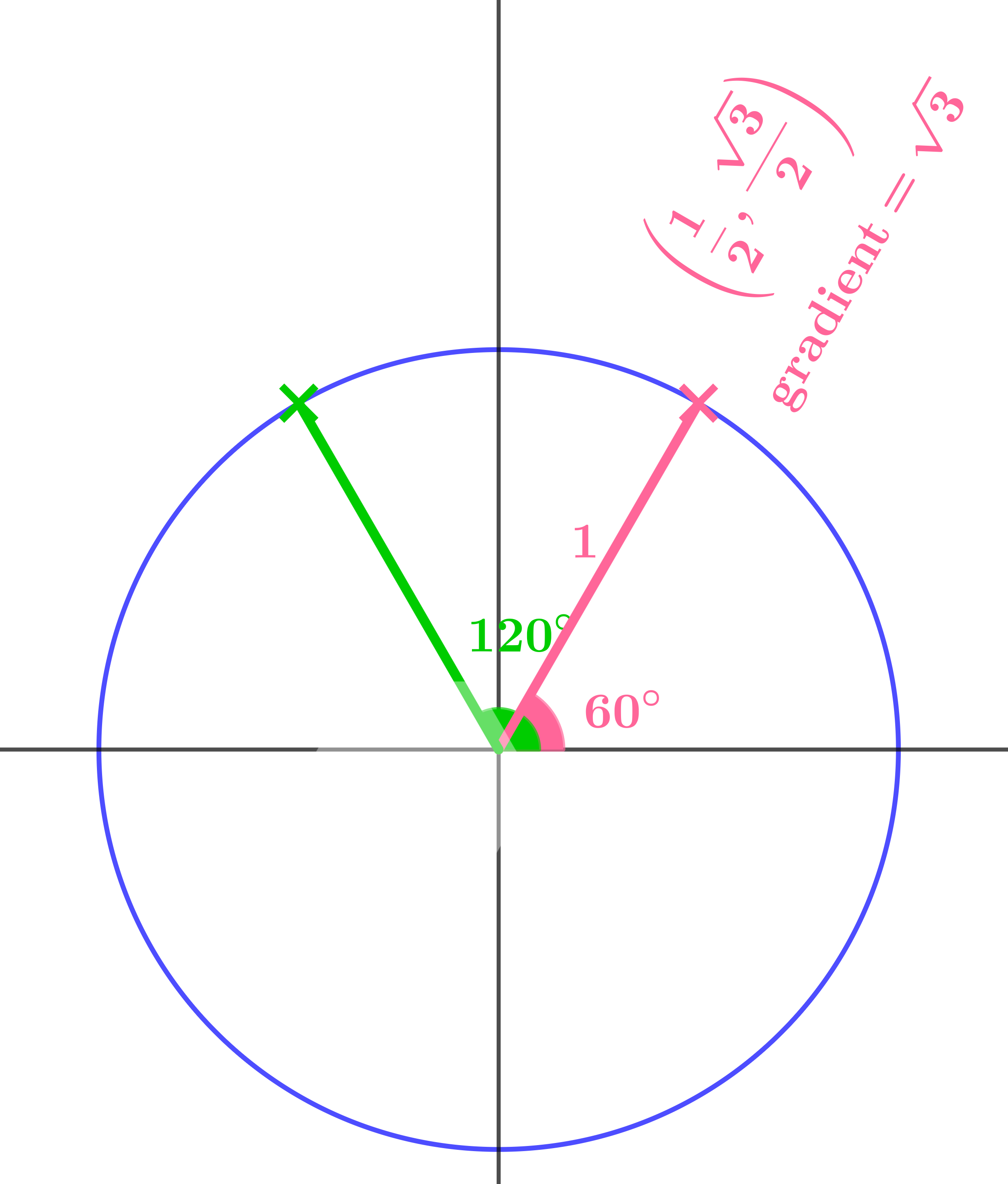
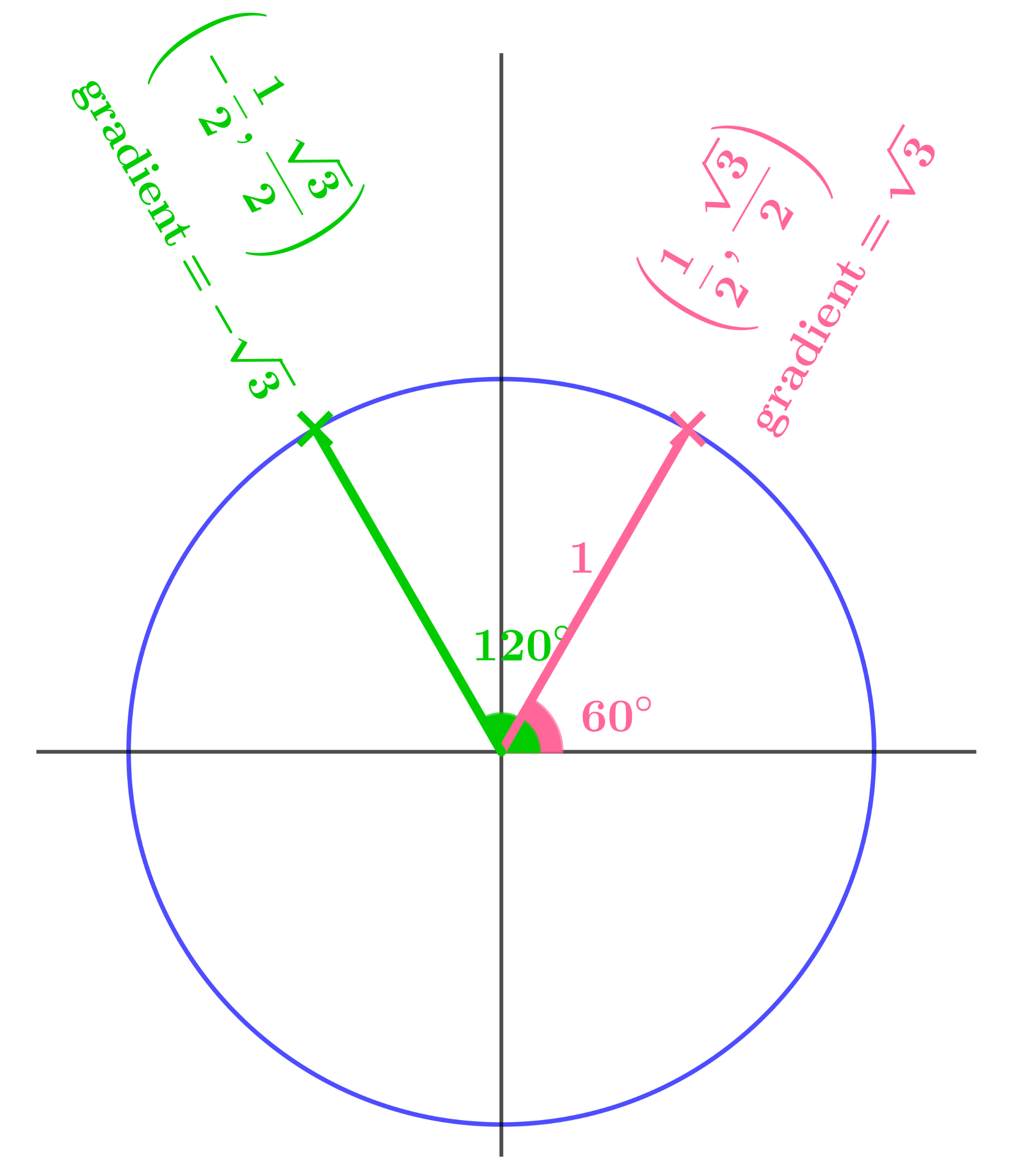
We can get the coordinates and gradient just by looking at the symmetry of the diagram.
Use this diagram to suggest values for sin, cos, and tan of \(120°\).
For the pink angle, cos is the \(x\) coordinate, sin is the \(y\) coordinate, and tan is the gradient. So the sensible option is to use the same definitions for the green angle to get:
| \(\cos 120° = -\dfrac{1}{2}\) | \(\sin 120° = \dfrac{\sqrt{3}}{2}\) | \(\tan 120° = -\sqrt{3}\) |
Find the coordinates of the orange and blue points and the gradients of the two radiuses, and use these to suggest values for sin, cos, and tan of \(240°\) and \(300°\).
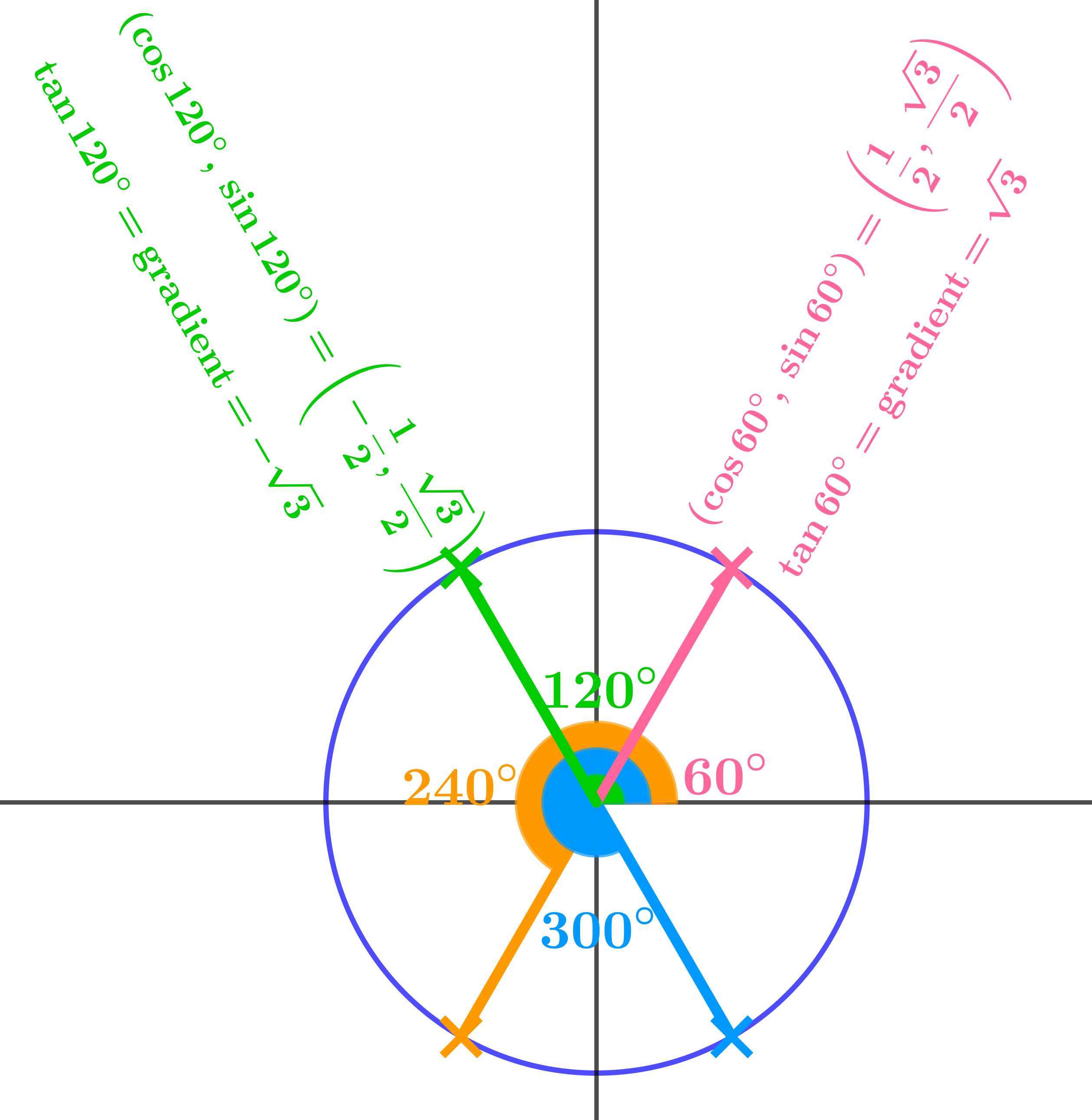
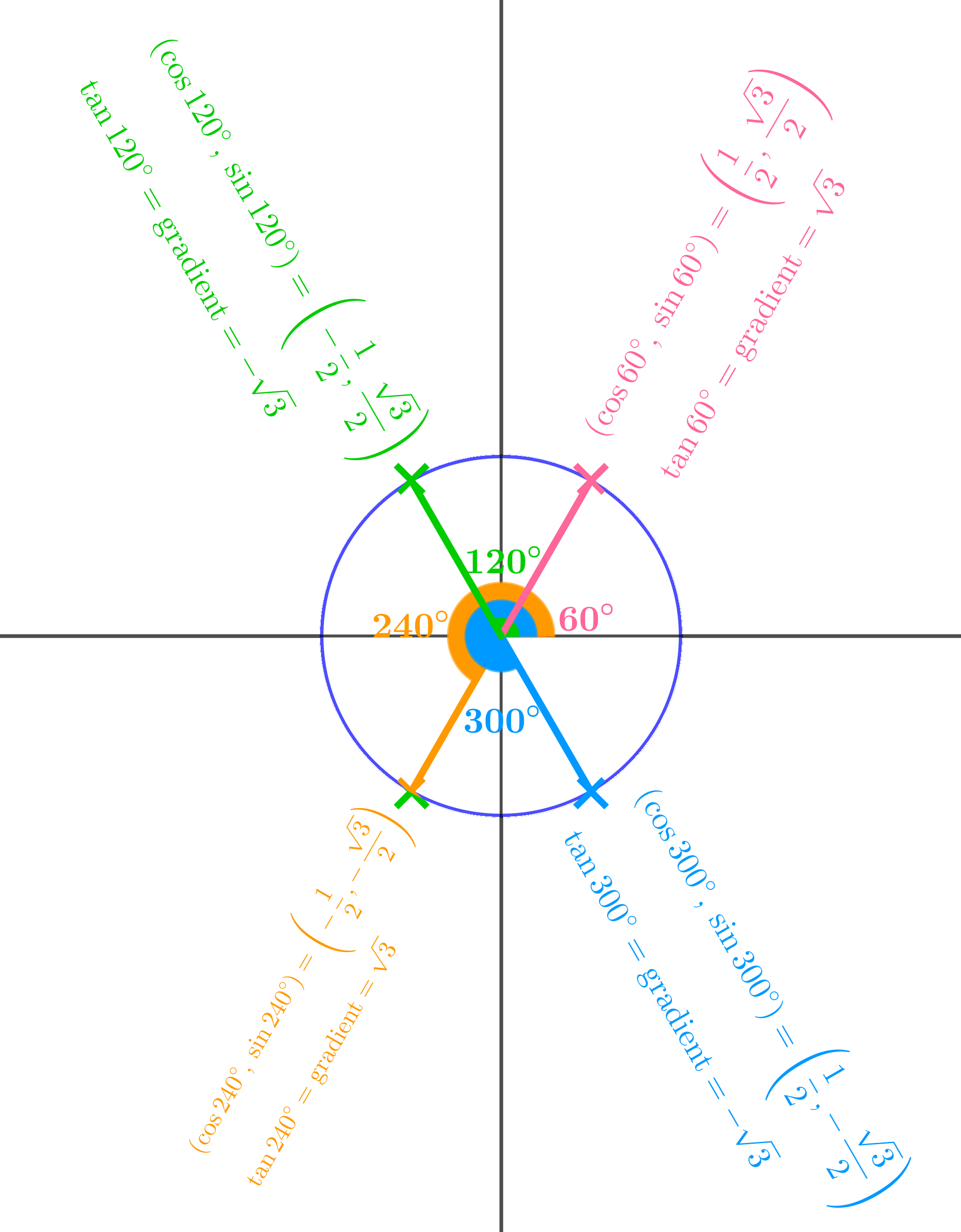
\[(\cos 240°, \sin 240°) = \left(-\dfrac{1}{2}, -\dfrac{\sqrt{3}}{2}\right),\quad \text{gradient}= \tan 240° = \sqrt{3}\]
\[(\cos 300°, \sin 300°) = \left(\dfrac{1}{2}, -\dfrac{\sqrt{3}}{2}\right),\quad \text{gradient}= \tan 300° = -\sqrt{3}\]
Now we know how to define sin, cos, and tan of angles between \(0\) and \(360^\circ\). But there's more. We can extend our definitions of sin cos and tan to angles greater than \(360^\circ\).
What are sin, cos, tan of \(420°\), \(780°\), \(1140°\), \(1500°\)?
This video should help.
They are all \(60^\circ+\) multiples of \(360^\circ\), so sin, cos, and tan are all the same as sin, cos, tan of \(60°\).
We can even extend our definitions of sin cos and tan to "negative" angles.
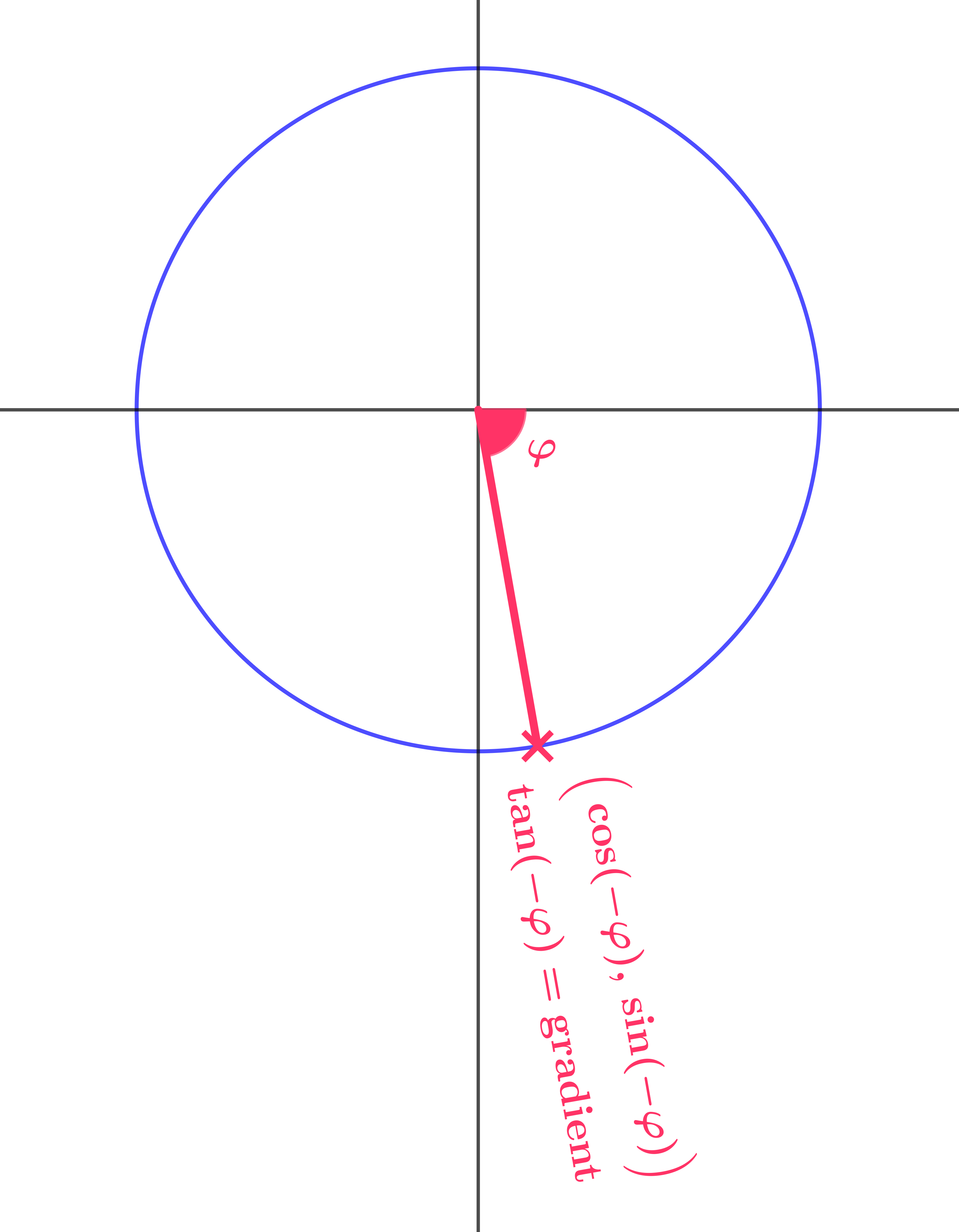
Use the blue point on this diagram to suggest values for sin, cos, tan of \(-60°\).
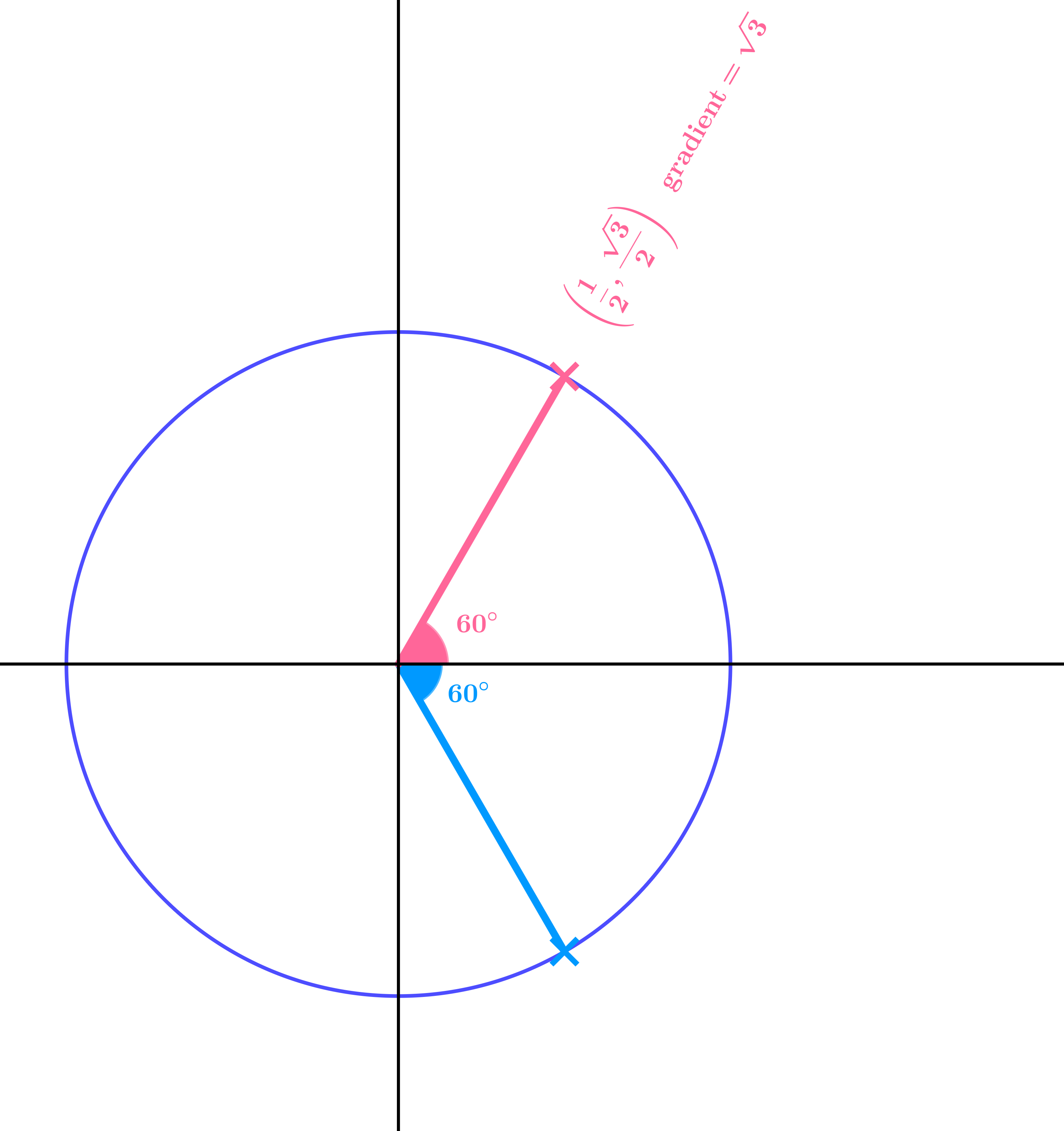
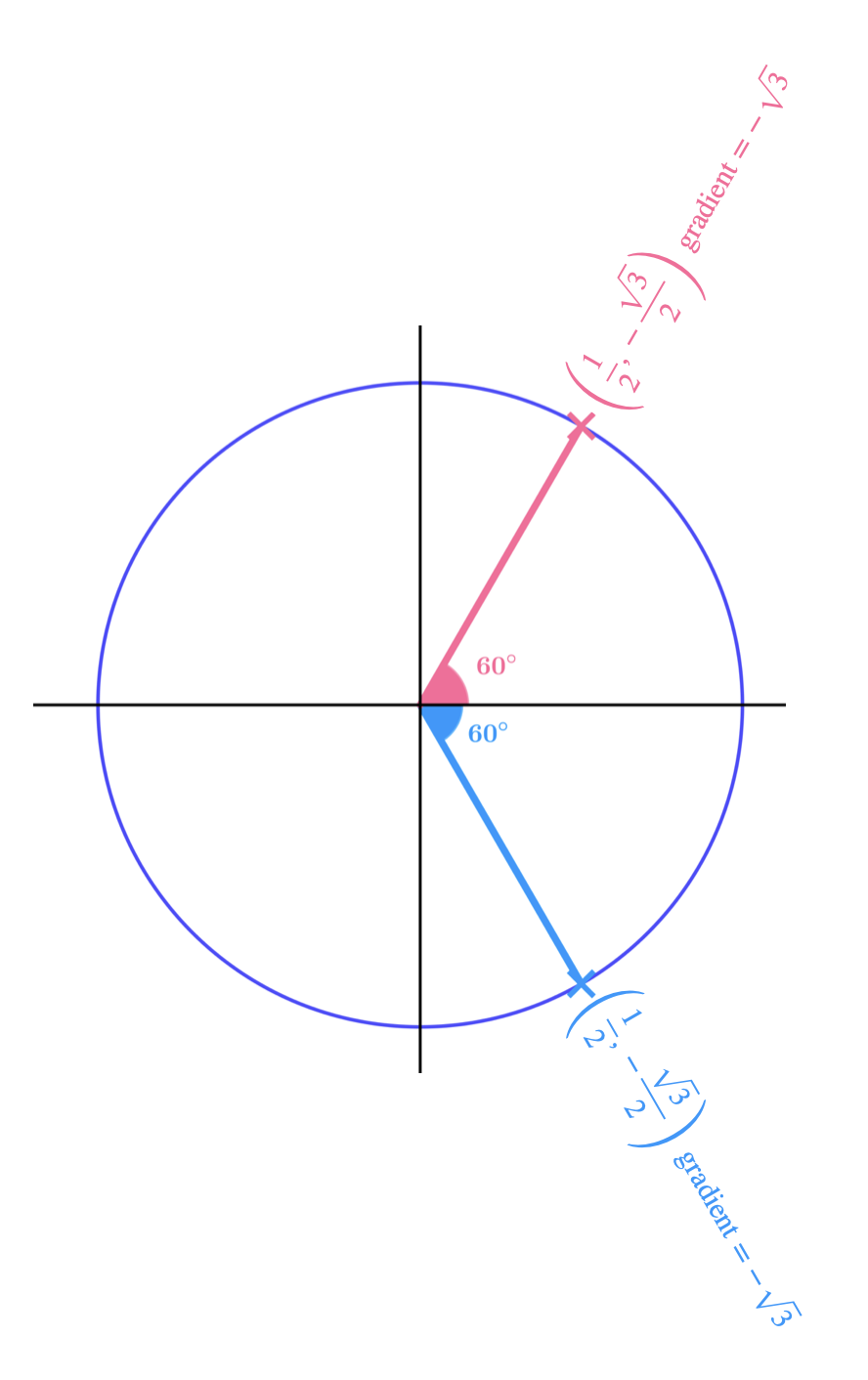
Angles are measured from the positive \(x\) axis in the anticlockwise direction, so a negative angle must be measured backwards in the anticlockwise direction. That is, in the clockwise direction. From the geometrical point of view, the angle size is still positive, but from the point of view of circular functions like sin, cos, and tan, the angle counts as negative.
| \(\cos(-60°) = \dfrac{1}{2}\) | \(\sin(-60°) = -\dfrac{\sqrt{3}}{2}\) | \(\tan(-60°) = -\sqrt{3}\) |
Suggest values for sin, cos, tan of \(-120°\), \(-240°\), \(-300°\).
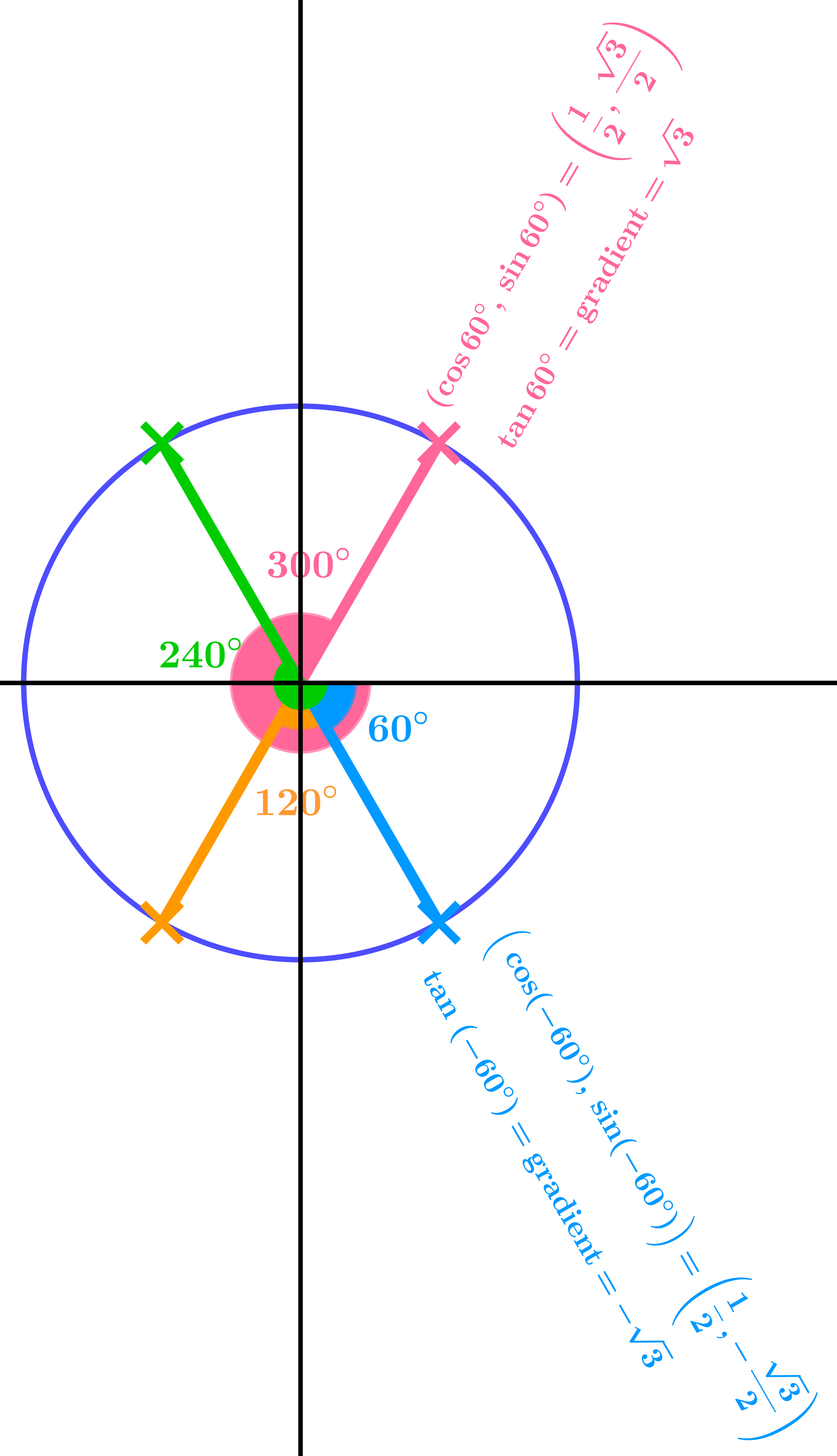
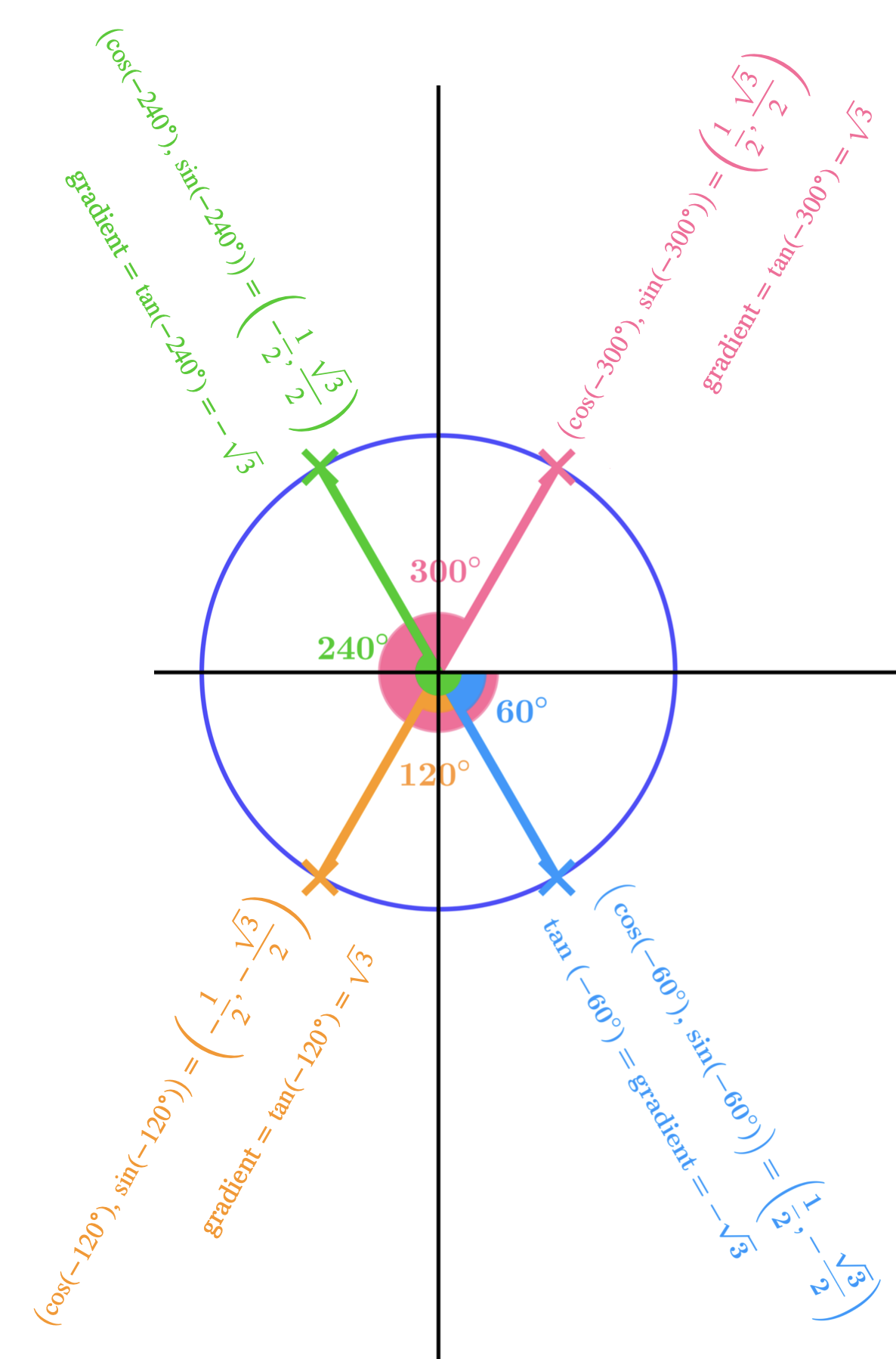
| \(\cos(-60°) = \dfrac{1}{2}\) | \(\sin(-60°) = -\dfrac{\sqrt{3}}{2}\) | \(\tan(-60°) = -\sqrt{3}\) |
| \(\cos(-120°) = -\dfrac{1}{2}\) | \(\sin(-120°) = -\dfrac{\sqrt{3}}{2}\) | \(\tan(-120°) = \sqrt{3}\) |
| \(\cos(-240°) = -\dfrac{1}{2}\) | \(\sin(-240°) = \dfrac{\sqrt{3}}{2}\) | \(\tan(-240°) = -\sqrt{3}\) |
| \(\cos(-300°) = \dfrac{1}{2}\) | \(\sin(-300°) = \dfrac{\sqrt{3}}{2}\) | \(\tan(-300°) = \sqrt{3}\) |
Suggest values for sin, cos, tan of \(-660°\), \(-1020°\), \(-1380°\), \(-1740°\).
Each of these "angles" has the same sin, cos, and tan as \(-300°\).
These diagrams essentially form definitions of sin, cos, and tan of any number (angle).
There are other ways to define these functions using, for example, graphs or power series, but this one makes intuitive sense and forms a reliable foundation for what is to come.
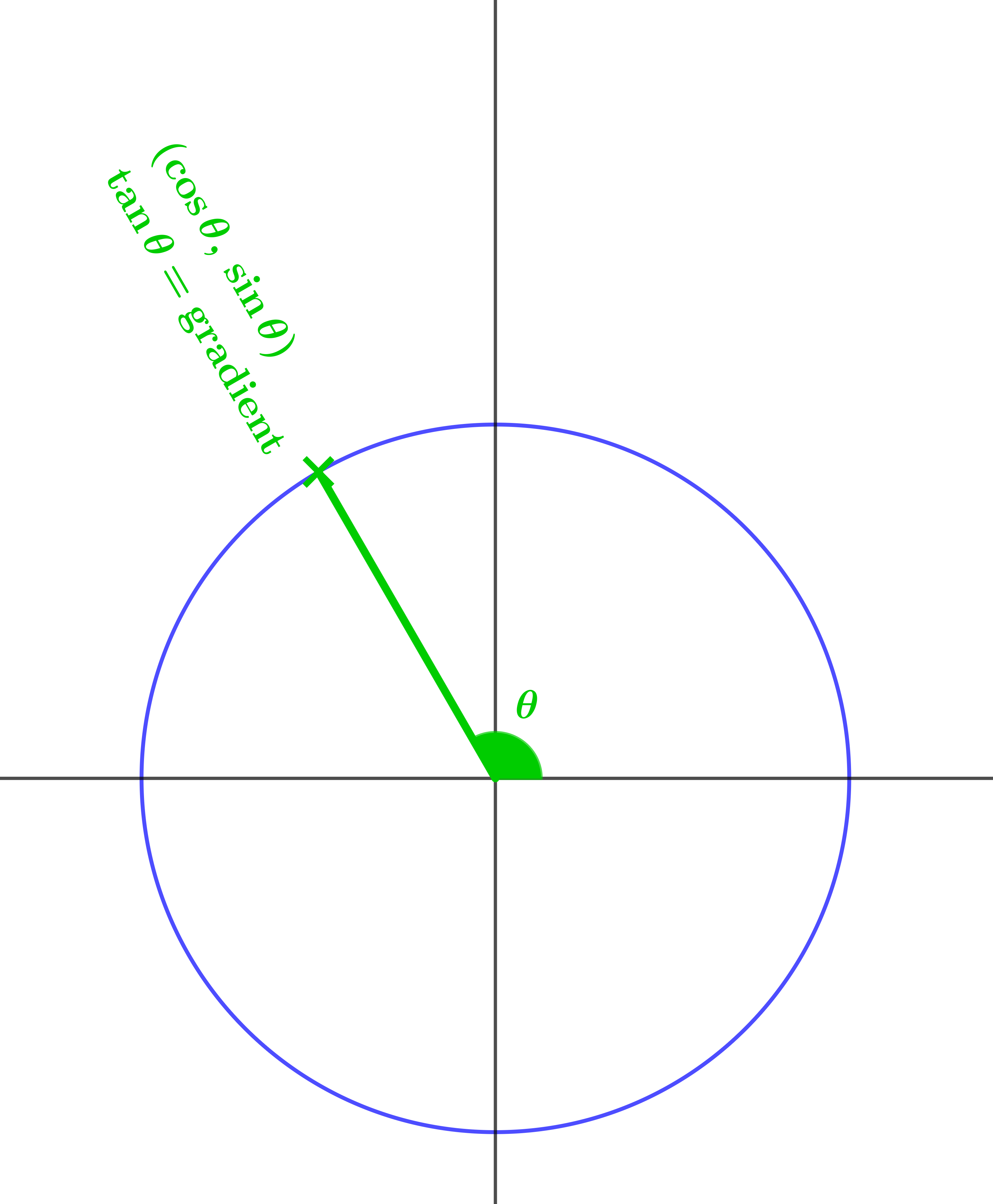
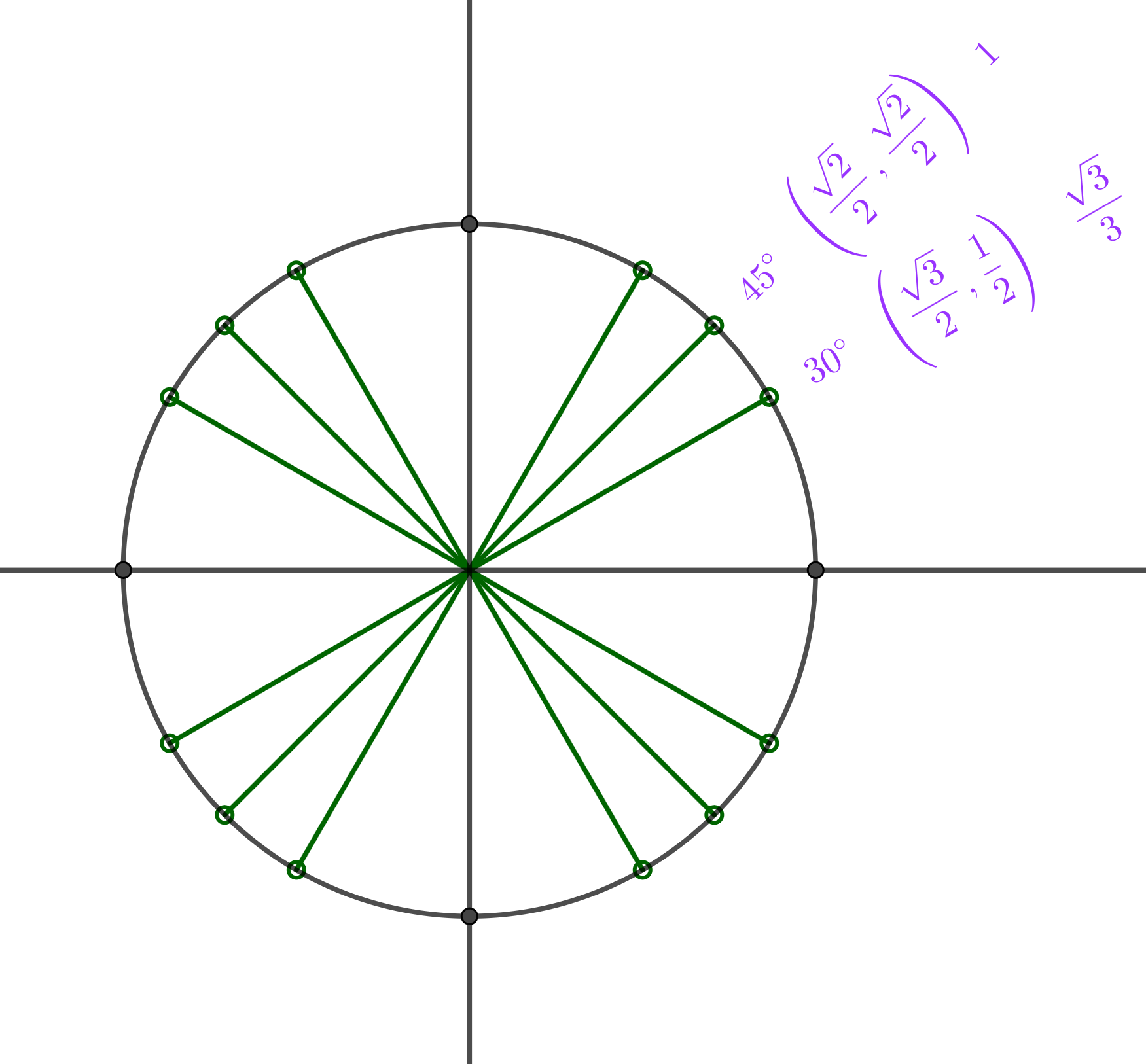
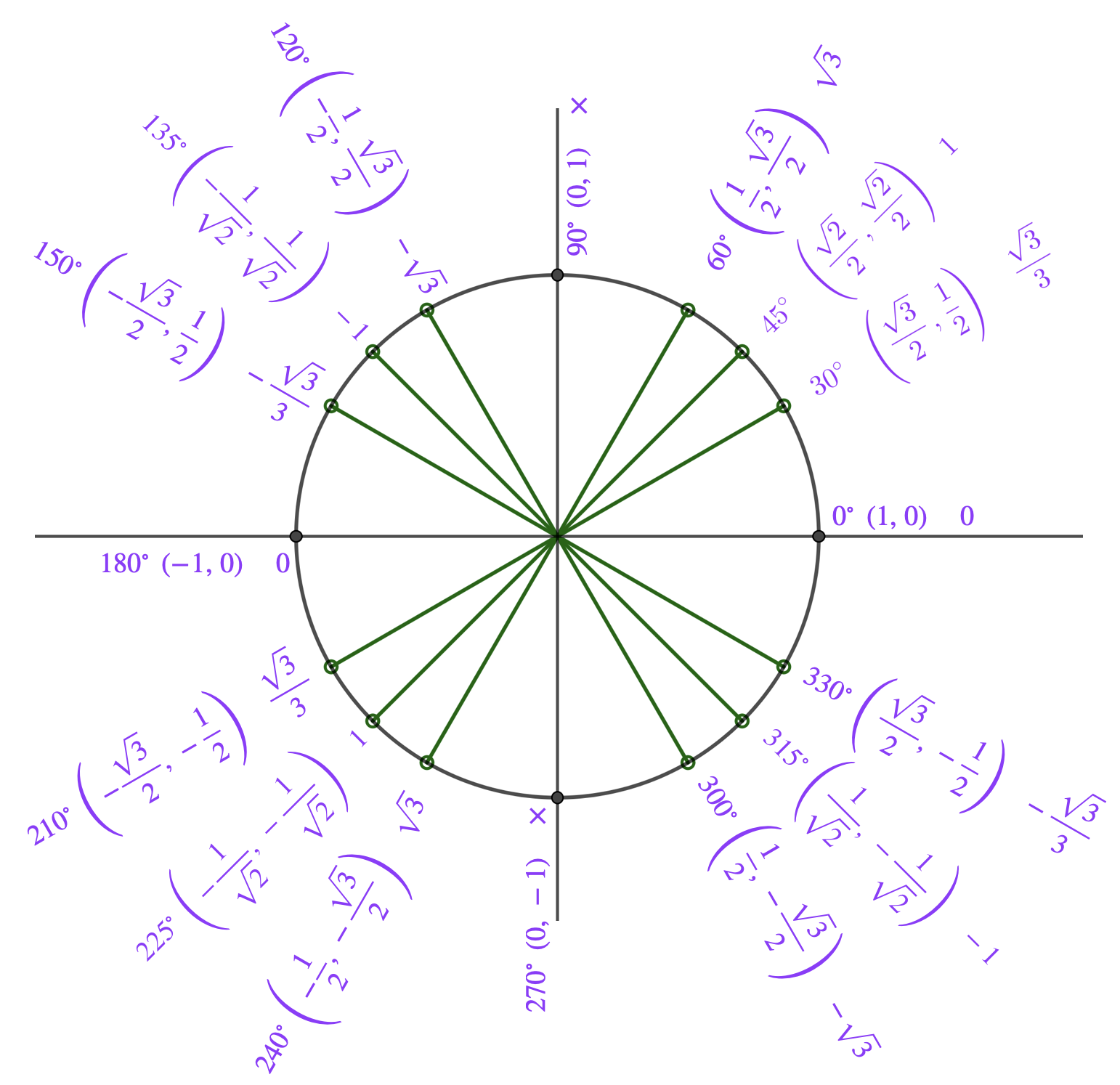
Of course, all our examples on this journey have been angles for which the values of sin, cos, and tan are easy to write down in their exact forms. Most of the time, you will have to rely on your calculator for the values of the functions to a certain accuracy. I cannot overstate, though, the value of learning these standard values. Partly this is to save time, but mostly it is so that every time you retrieve them from your memory, you reinforce your understanding of the relationship between the unit circle and the circular functions. You reinforce your understanding of cos as an \(x\) coordinate, sin as a \(y\) coordinate, and tan as a gradient.
With this in mind, complete this diagram now.
Congratulations on completing the definitions stage!
You've now explored the foundations of circular functions and seen how they extend beyond the trigonometry of right-angled triangles. By understanding the unit circle and working through these definitions, you've built a solid foundation for everything that follows.
Keep practising that unit circle diagram—it's the key to mastering circular functions!
Dr Brian Brooks
Mathematics InSight