More or less every function you come across at school can be differentiated. Very few, however, can be integrated! If you make up a function involving polynomial, trigonometric, and exponential functions, the probability that your function can be integrated exactly is more or less zero. Maybe even zero. That’s not to say that there aren’t infinitely many exactly integrable functions—there are! But these are easily outweighed by the number that are not. Even so, we have some powerful techniques at our disposal for integrating a range of functions. For example, you may already know quite a bit about integration by substitution. This will crack plenty of integrals that don't seem obvious, but it can be frustrating. For example, try
Find $$\int \frac{1}{1+\cos x}\;\mathrm{d}x$$
You might be tempted to try a substitution. For example, you might try $$u=\cos x$$ or $$u=1+\cos x$$
Try each of these. Any success? Thought not!
I think, though, if I were to ask you to do $$\int \frac{1}{1+\cos 2x}\;\mathrm{d}x$$ you might find this pretty easy, using a well-known double-angle formula.
$$\begin{align*}\int \frac{1}{1+\cos 2x}\;\mathrm{d}x&=\int \frac{1}{1+2\cos^2 x-1}\;\mathrm{d}x\\[8pt] &=\int \frac{1}{2\cos^2 x}\;\mathrm{d}x\\[8pt] &=\frac{1}{2}\int \sec^2 x\;\mathrm{d}x\\[8pt] &=\frac{1}{2}\tan x \end{align*}$$
Find $$\int \frac{1}{1+\cos x}\;\mathrm{d}x$$
$$\begin{align*} \int \frac{1}{1+\cos x}\;\mathrm{d}x&=\int \frac{1}{2\cos^2\frac{x}{2}}\;\mathrm{d}x\\[8pt] &=\frac{1}{2}\int \sec^2\frac{x}{2}\;\mathrm{d}x\\[8pt] &=\tan\frac{x}{2}+k \end{align*}$$
If $$g(x)=\frac{\sin x}{1+\cos x}$$ find \(g'(x)\).
Then use this to find a different version of $$\int \frac{1}{1+\cos x}\;\mathrm{d}x$$
$$\begin{align*}g(x)&=\frac{\sin x}{1+\cos x}\\[8pt] \Rightarrow g'(x)&=\frac{(1+\cos x)\cos x-\sin x\times (-\sin x)}{(1+\cos x)^2}\\[8pt] &=\frac{\cos x+\cos^2 x+\sin^2 x}{(1+\cos x)^2}\\[8pt] &=\frac{1+\cos x}{(1+\cos x)^2}\\[8pt] &=\frac{1}{1+\cos x}\\[8pt] \Rightarrow \int \frac{1}{1+\cos x}\;\mathrm{d}x&=\frac{\sin x}{1+\cos x} \end{align*}$$
If $$h(x)=\frac{1-\cos x}{\sin x}$$ find \(h'(x)\).
Then use this to find a different version of $$\int \frac{1}{1+\cos x}\;\mathrm{d}x$$
$$\begin{align*}h(x)&=\frac{1-\cos x}{\sin x}\\[8pt] \Rightarrow h'(x)&=\frac{\sin x\sin x -(1-\cos x)\cos x}{\sin^2 x}\\[8pt] &=\frac{\sin^2 x+\cos x+\cos^2 x}{\sin^2 x}\\[8pt] &=\frac{1+\cos x}{(1+\cos x)^2}\\[8pt] &=\frac{1}{1+\cos x}\\[8pt] \Rightarrow \int \frac{1}{1+\cos x}\;\mathrm{d}x&=\frac{1-\cos x}{\sin x} \end{align*}$$
Now we have three versions of $$\int \frac{1}{1+\cos x}\;\mathrm{d}x$$ Show that they are all equivalent.
\begin{align*} \frac{\sin x}{1+\cos x}&=\frac{2\sin\frac{x}{2}\cos \frac{x}{2} }{2\cos^2\frac{x}{2}}=\tan\frac{x}{2} \end{align*}
If \(t=\tan\frac{x}{2}\), find $$\frac{\mathrm{d}x}{\mathrm{d}t}$$ Use this substitution to tackle $$\int \frac{1}{1+\cos x}\;\mathrm{d}x$$
$$\begin{align*} &t=\tan\frac{x}{2}\\[8pt] \Rightarrow &\frac{\mathrm{d}t}{\mathrm{d}x}=\frac{1}{2}\sec^2\frac{x}{2}\\[36pt] \int \frac{1}{1+\cos x}\;\mathrm{d}x&=\int \frac{1}{1+\cos x}\frac{\mathrm{d}x}{\mathrm{d}t}\;\mathrm{d}u\\[8pt] &=\int \frac{1}{1+\cos x}\times \frac{2}{\sec^2\frac{x}{2}}\;\mathrm{d}t\\[8pt] &=\int \frac{1}{2\cos^2\frac{x}{2}}\times \frac{2}{\sec^2\frac{x}{2}}\;\mathrm{d}t\\[8pt] &=\int\;\mathrm{d}t\\[8pt] &=t+k\\[8pt] &=\tan\frac{x}{2}+k \end{align*}$$
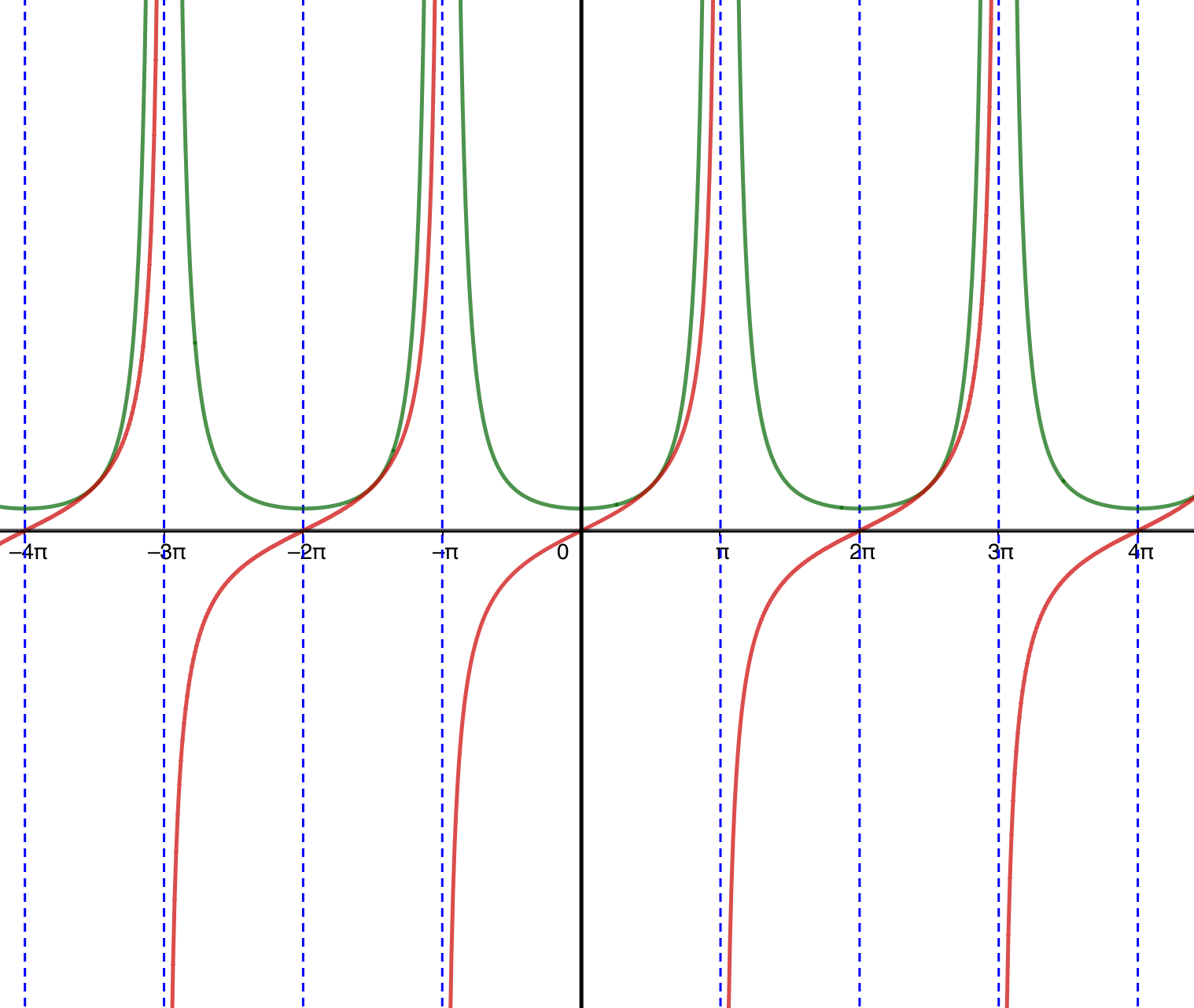
Use the substitution $$u=\int_0^x f(x)\;\mathrm{d}x$$ to find $$\int f(x)\;\mathrm{d}x$$
$$\begin{align*} \int f(x)\;\mathrm{d}x&=\int f(x)\frac{\mathrm{d}x}{\mathrm{d}u}\;\mathrm{d}u\\[8pt] &=\int f(x)\times\frac{1}{f(x)}\;\mathrm{d}u\\[8pt] &=\int\;\mathrm{d}u\\[8pt] &=u+k\\[8pt] &=\int f(x)\;\mathrm{d}x \end{align*}$$
Find $$\int\frac{1}{\cos x}\;\mathrm{d}x$$.
$$\begin{align*} \int\frac{1}{\cos x}\;\mathrm{d}x&=\int\frac{1+t^2}{1-t^2}\frac{2}{1+t^2}\;\mathrm{d}t\\[8pt] &=\int\frac{2}{1-t^2}\;\mathrm{d}x\\[8pt] &=\int\frac{2}{(1-t)(1+t)}\;\mathrm{d}t\\[8pt] &=\int\frac{1}{1+t}+\frac{1}{1-t}\;\mathrm{d}t\\[8pt] &=\ln(1+t)-\ln(1-t)+k\\[8pt] &=\ln\frac{1+t}{1-t}+k\\[8pt] &=\ln\frac{1+\tan\frac{x}{2}}{1-\tan\frac{x}{2}}+k \end{align*}$$
Find $$\int\frac{1}{1+\sin x}\;\mathrm{d}x$$.