What is the sum of the two shaded angles?
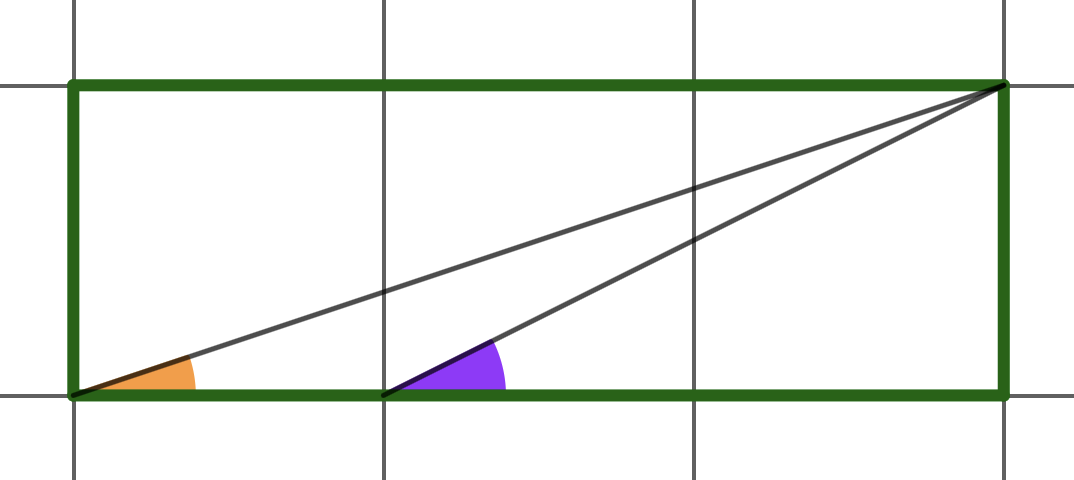
What is the sum of the two shaded angles?
Here is a diagram that should help.
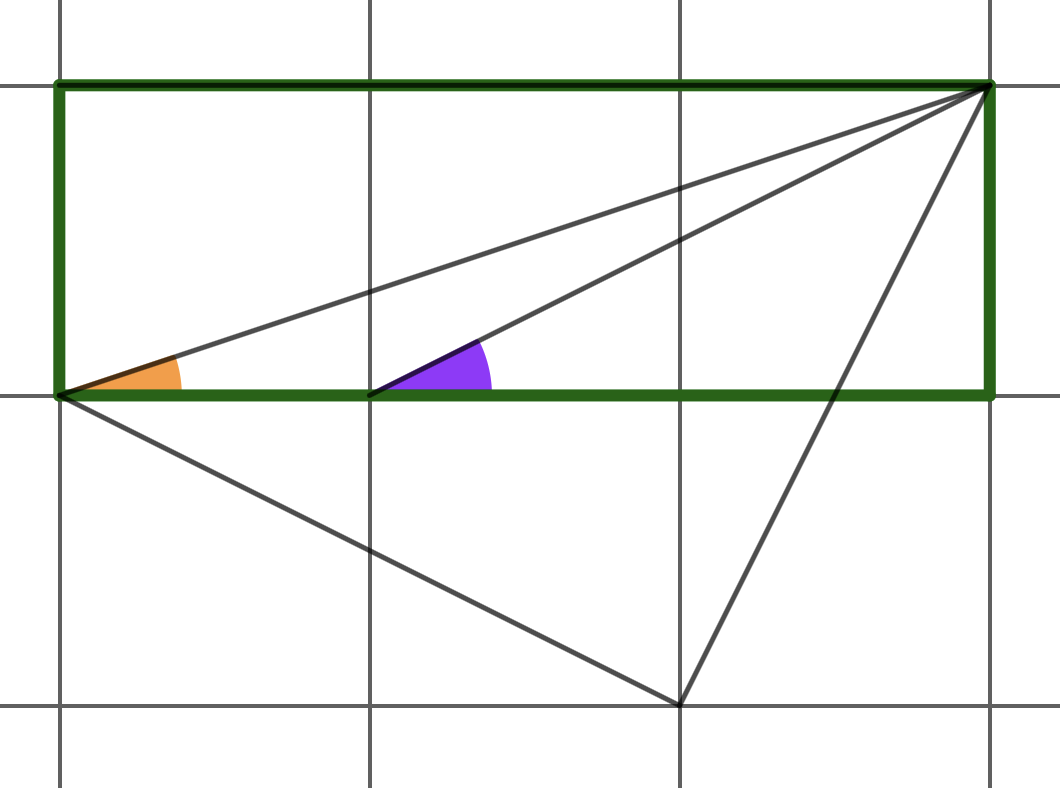
Are any other angles the same as either of the shaded angles?
The purple shaded angle is formed by going along \(2\) and up or down \(\).
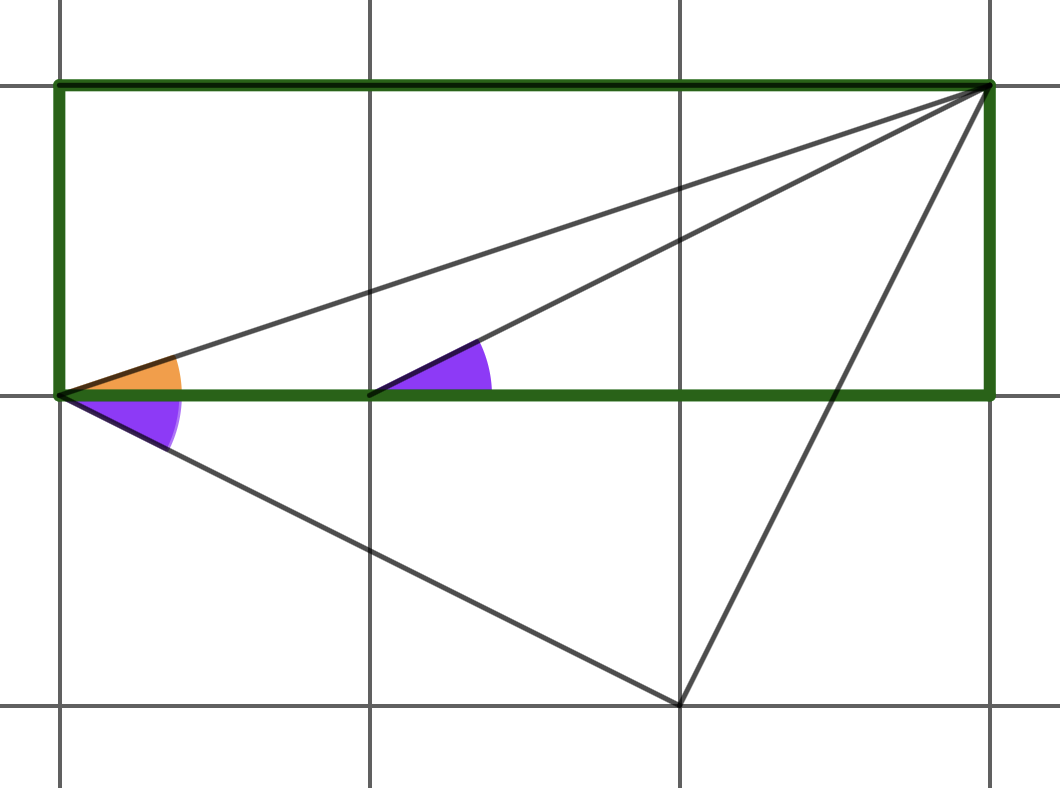
What kind of triangle is this?
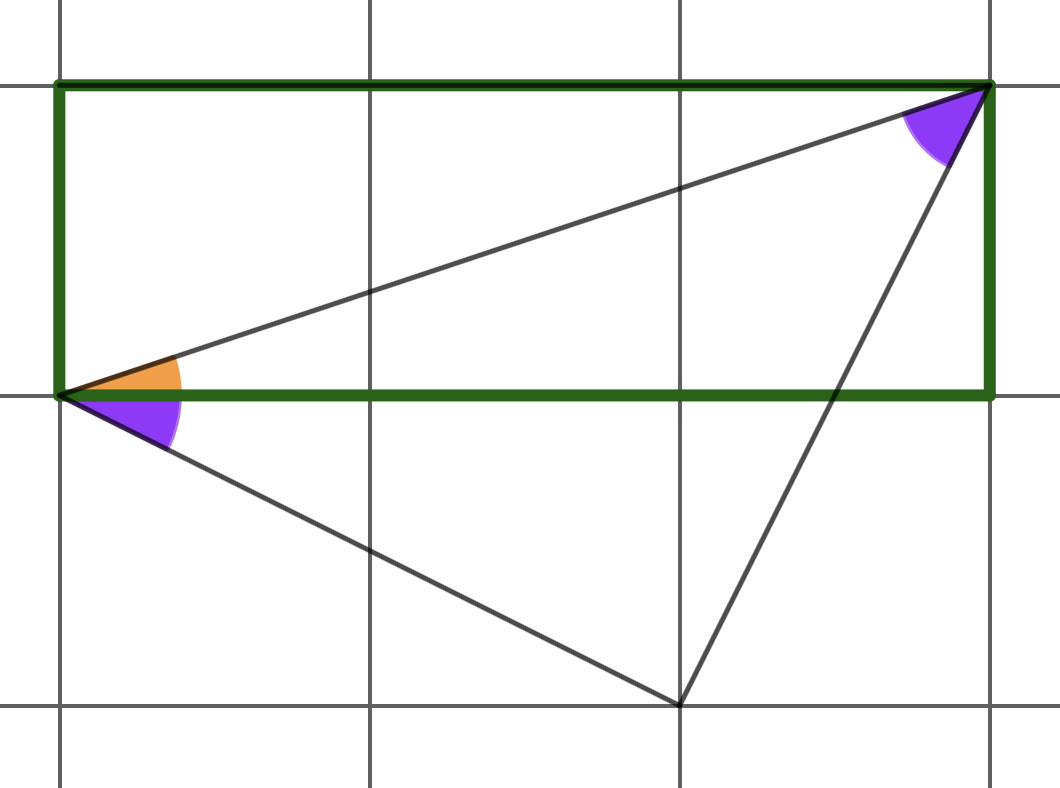
The triangle is right-angled and isosceles, so the sum of the two shaded angles is \(45^\circ\).
That's a lovely geometrical approach to the problem. Trigonometry gives another way of attacking the problem that is much less intuitive, but is also much easier to extend.
If the two angles are \(\theta\) and \(\varphi\), what is \(\tan(\theta+\varphi)\), and what does that tell us about the sum of the two angles?
We can write this another way: $$\tan^{-1}\frac{1}{2}+\tan^{-1}\frac{1}{3}=\tan^{-1}1$$
What are: \[\tan^{-1}\frac{1}{5}+\tan^{-1}\frac{1}{8}\text{ and}\] \[\tan^{-1}\frac{1}{2}+\tan^{-1}\frac{1}{5}+\tan^{-1}\frac{1}{8}?\]
and
$$\begin{aligned} \tan^{-1}\frac{1}{2}+\tan^{-1}\frac{1}{5}+\tan^{-1}\frac{1}{8}&=\tan^{-1}\frac{1}{2}+\tan^{-1}\frac{1}{3}\\[12pt] &=\tan^{-1}1=\frac{\pi}{4} \end{aligned}$$Can you come up with a geometrical interpretation of these results?
First, let's go back to the original problem, and take a look at another diagram.
How does this diagram show that the shaded angles sum to \(\frac{\pi}{4}\)?
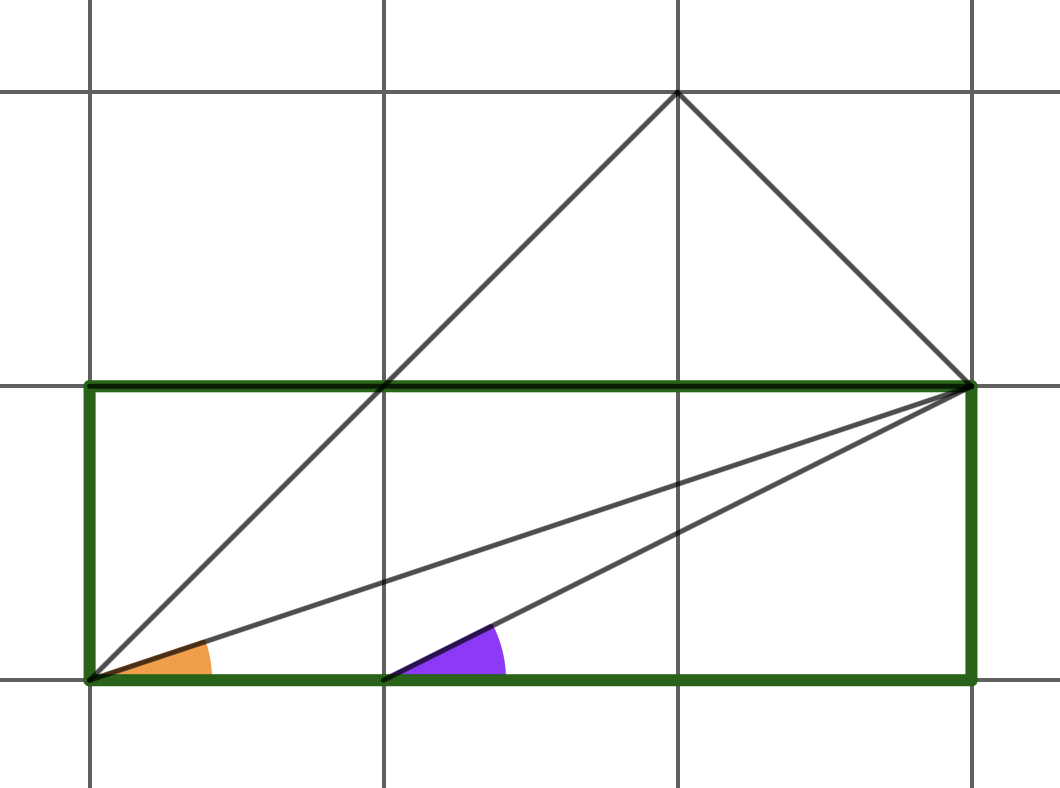
The two shaded triangles are similar (count the squares and diagonals).
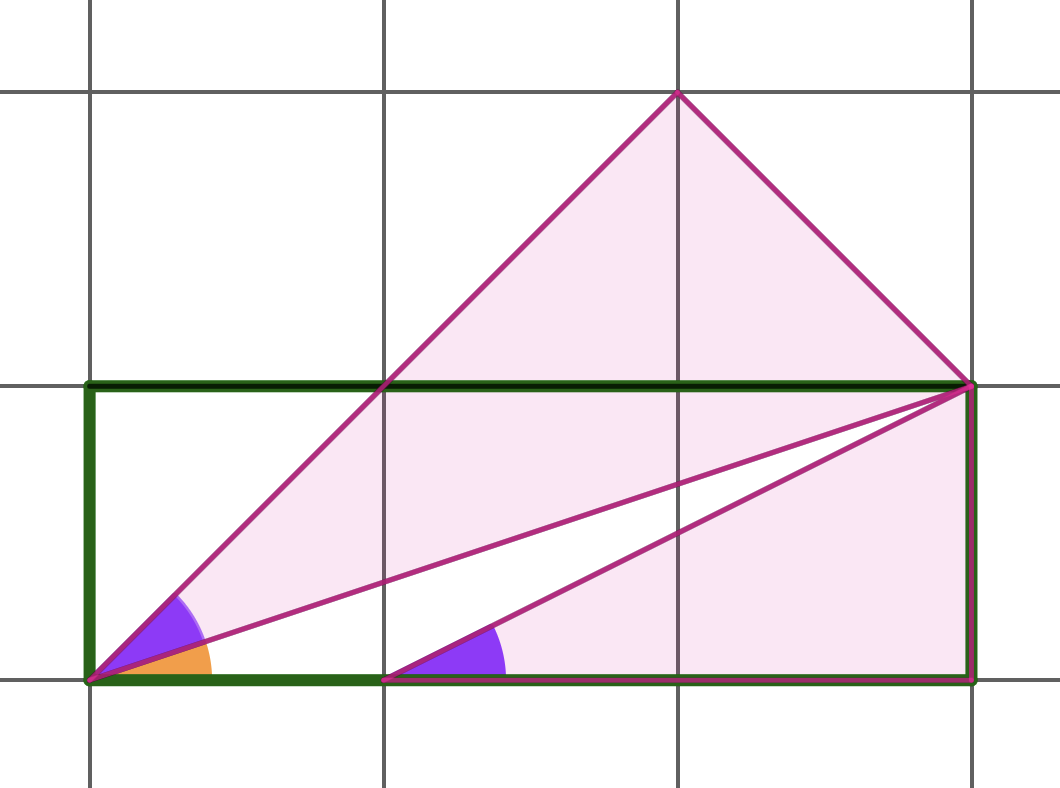
Now what does the yellow shaded triangle tell you about the sum of the two shaded angles?
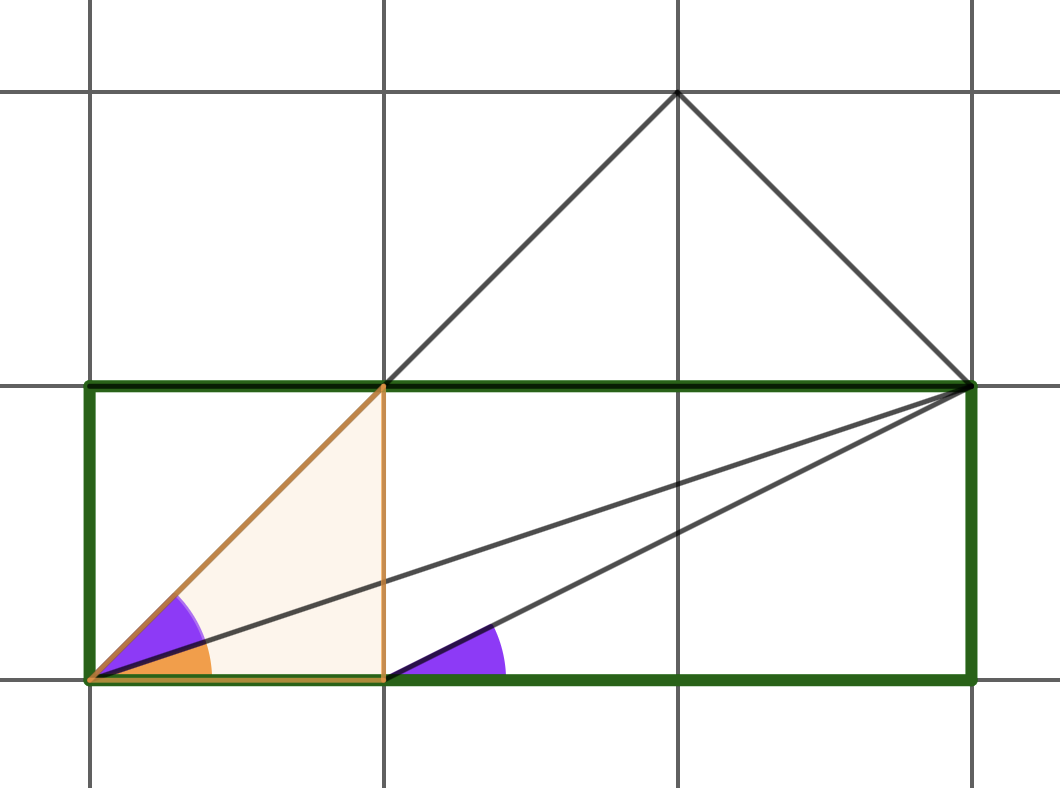
It's isosceles, so again, $$\tan^{-1}\frac{1}{2}+\tan^{-1}\frac{1}{3}=\tan^{-1}1$$
This diagram extends to this one:
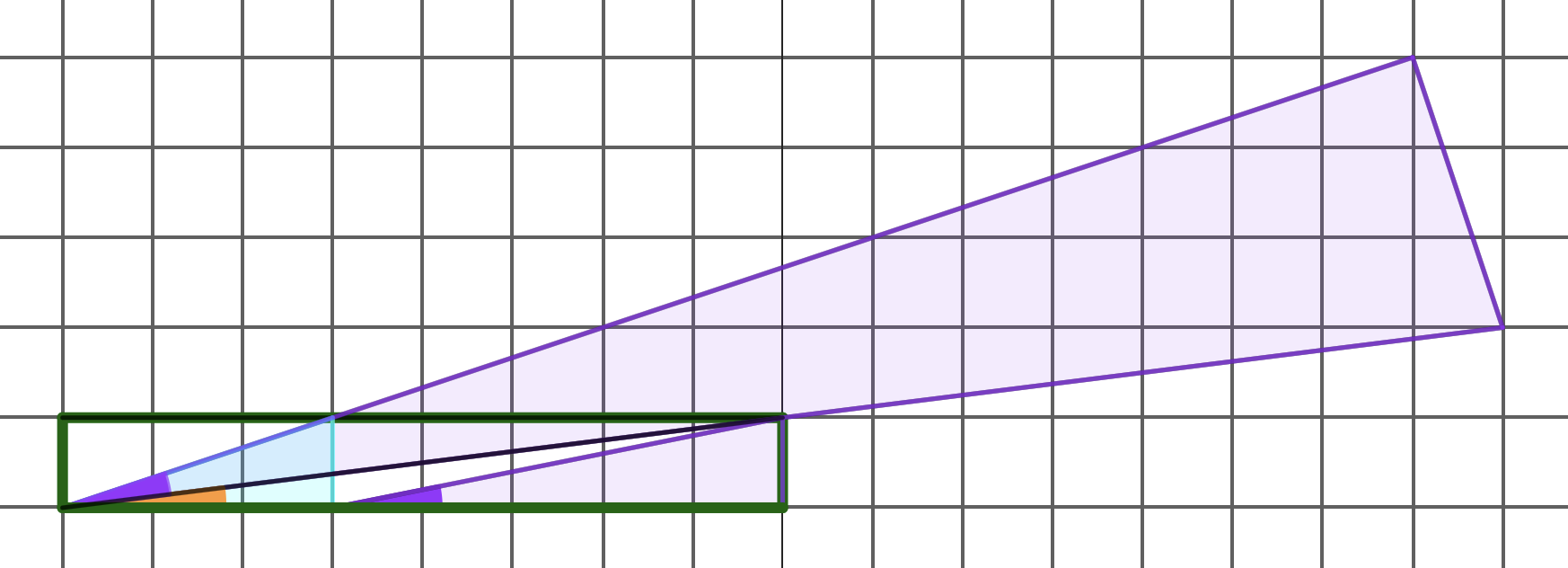
What are the two shaded angles, and what does the diagram tell us about their sum?
It shows that $$\tan^{-1}\frac{1}{5}+\tan^{-1}\frac{1}{8}=\tan^{-1}\frac{1}{3}$$ so that $$ \begin{aligned} \tan^{-1}\frac{1}{2}+\tan^{-1}\frac{1}{5}+\tan^{-1}\frac{1}{8}&= \tan^{-1}\frac{1}{2}+\tan^{-1}\frac{1}{3}\\[1em] &=\tan^{-1}1=45^\circ \end{aligned}$$
Next, try this: $$\tan^{-1}\frac{1}{13}+\tan^{-1}\frac{1}{21}$$ and this: $$ \text{tan}^{-1}\frac{1}{2}+\tan^{-1}\frac{1}{5}+\tan^{-1}\frac{1}{13}+\tan^{-1}\frac{1}{21}$$
What do you notice about all the denominators of the fractions so far?
They are all Fibonacci numbers. This suggests a line of enquiry that we will follow soon.
In the meantime, let's see if there are any (other) integer solutions to $$\tan^{-1}\frac{1}{a}+\tan^{-1}\frac{1}{b}=\tan^{-1}\frac{1}{c}$$
Using the compound angle formula for tan gives $$\begin{aligned}&\frac{\frac{1}{a}+\frac{1}{b}}{1-\frac{1}{a}\frac{1}{b}}=\frac{1}{c}\\[1em] \Rightarrow &c=\frac{ab-1}{a+b} \end{aligned}$$
Can you find any integer solutions to this?
If $$\tan^{-1}\frac{1}{a}+\tan^{-1}\frac{1}{b}=\tan^{-1}\frac{1}{c}$$ what do we know about the relative sizes of \(a\), \(b\), and \(c\)?
Well, the angle on the right of the equation is clearly bigger that either of the angles on the left, so $$\begin{aligned} \tan^{-1}\frac{1}{a}<\tan^{-1}\frac{1}{c}&\text{ and }\tan^{-1}\frac{1}{b}<\tan^{-1}\frac{1}{c}\\[12pt] \Rightarrow\frac{1}{a}<\frac{1}{c}&\text{ and }\frac{1}{b}<\frac{1}{c}\\[12pt] \Rightarrow c< a&\text{ and }c< b \end{aligned}$$ Of course \(a\) and \(b\) can be in either order, so to make life manageable, lets agree to choose \(a\) and \(b\) so that \(a< b\). That means $$c< a< b$$
If we are looking for solutions to $$\tan^{-1}\frac{1}{a}+\tan^{-1}\frac{1}{b}=\tan^{-1}\frac{1}{c}$$ then we can make our lives easier by starting with a possible value for \(a\) so that we have a definite upper bound for \(c\).
For example, take \(a=4\). Then
$$\tan^{-1}\frac{1}{4}+\tan^{-1}\frac{1}{b}=\tan^{-1}\frac{1}{c}$$
which means that
$$\frac{4b-1}{4+b}=c$$
We now know that \(c< 4\), so we only need to try \(2\) and \(3\) for \(c\).
Rearranging, we get $$b=\frac{4c+1}{4-c}=\frac{9}{2}\text{ or }\frac{13}{1}$$ from which
we can see that the only possible values for \(b\) and \(c\) are \(13\) and \(3\), giving
$$\tan^{-1}\frac{1}{4}+\tan^{-1}\frac{1}{13}=\tan^{-1}\frac{1}{3}$$
Try the same process for \(a=5,\;6,\;\dots\)
When \(a=5\), we have \(c=2, 3, \text{ or }4\) and $$b=\frac{5c+1}{5-c}=\frac{11}{3},\;\frac{16}{2},\;\frac{21}{1}$$ So $$\tan^{-1}\frac{1}{5}+\tan^{-1}\frac{1}{8}=\tan^{-1}\frac{1}{3}$$ $$\tan^{-1}\frac{1}{5}+\tan^{-1}\frac{1}{21}=\tan^{-1}\frac{1}{4}$$ and the first of those is one that we have already seen.
Here are the Fibonacci numbers:
$$0,\;1,\;1,\;2,\;3,\;5,\;8,\;13,\;21,\;34,\;55,\;80,\;\dots$$
So far, we have seen that
$$\tan^{-1}\frac{1}{1}=\tan^{-1}\frac{1}{2}+\tan^{-1}\frac{1}{3}$$
$$\tan^{-1}\frac{1}{3}=\tan^{-1}\frac{1}{5}+\tan^{-1}\frac{1}{8}$$
$$\tan^{-1}\frac{1}{8}=\tan^{-1}\frac{1}{13}+\tan^{-1}\frac{1}{21}$$
and we might even argue that
$$\tan^{-1}\frac{1}{0}=\tan^{-1}\frac{1}{1}+\tan^{-1}\frac{1}{1}$$
since \[\frac{\pi}{2}=\frac{\pi}{4}+\frac{\pi}{4}\]
So it looks as though the denominators are three consecutive Fibonacci numbers in order.
But it's not every group of three. Only every other one.
Using \(F_n\) for the \(n^{\mathrm{th}}\) Fibonacci number, and taking \(F_0=0\), can you form a hypothesis by generalising this observation?
We know that $$\tan^{-1}\frac{1}{F_2}=\tan^{-1}\frac{1}{F_3}+\tan^{-1}\frac{1}{F_4}$$ $$\tan^{-1}\frac{1}{F_4}=\tan^{-1}\frac{1}{F_5}+\tan^{-1}\frac{1}{F_6}$$ $$\tan^{-1}\frac{1}{F_6}=\tan^{-1}\frac{1}{F_7}+\tan^{-1}\frac{1}{F_8}$$ and even $$\tan^{-1}\frac{1}{F_0}=\tan^{-1}\frac{1}{F_1}+\tan^{-1}\frac{1}{F_2}$$ So to generalise this, we could try: $$\tan^{-1}\frac{1}{F_{2n}}=\tan^{-1}\frac{1}{F_{2n+1}}+\tan^{-1}\frac{1}{F_{2n+2}}$$
How could we test this hypothesis?
Remember from earlier that $$c=\frac{ab-1}{a+b}$$ So if our hypothesis is true, then $$F_{2n}=\frac{F_{2n+1}F_{2n+2}-1}{F_{2n+1}+F_{2n+2}}$$ Is this always true? If so, then $$\begin{aligned}&F_{2n}=\frac{F_{2n+1}F_{2n+2}-1}{F_{2n+1}+F_{2n+2}}\\[1em] \Rightarrow &F_{2n}\left(F_{2n+1}+F_{2n+2}\right)=F_{2n+1}F_{2n+2}-1\\ \end{aligned} $$
Simplify this as far as you can, remembering that \(F_{2n+2}=F_{2n+1}+F_{2n}\).
So many subscripts! Let's make life easier. Use:
$$F_{6}\left(F_{7}+F_{8}\right)=F_{7}F_{8}-1$$
Then
$$\begin{aligned}
&F_{6}\left(F_{7}+F_{8}\right)=F_{7}F_{8}-1\\[1em]
\Rightarrow &F_{6}\left(F_{7}+F_{8}\right)=F_{7}\left(F_{6}+F_{7}\right)-1\\[1em]
\Rightarrow &F_6F_8=F_7^2-1\\[1em]
\Rightarrow &F_7^2-F_6F_8=1\\[1em]
\end{aligned}$$
or more generally
$$F_{2n+1}^2-F_{2n}F_{2n+2}=1$$
So if we can prove that this is always true for Fibonacci numbers, then we will have proved that our
hypothesis is correct.
This formula goes by the name "Cassini's Identity". Cassini had many interests in mathematics, astronomy,
and engineering, but he is now best known for his work in astronomy at a time (he was just a little older
than Newton) when our knowledge of the world was being firmly placed within a rational, scientific
framework. This was the scientific revolution.
So much for Cassini the man. Look him up! But what about his identity. Since I've already
told you it has a name, it must certainly be true, but proving it is not totally
straightforward.
First of all, let's check that \(F_7^2-F_6F_8=1\).
Well, \(F_7^2-F_6F_8=13^2-8\times21=1\), so yes, it is true. And we could try as many other cases as we like and find it to always be true. But that's not a proof.
This is a classic case for induction. To see how this is going to work, well start with a relatively easy case:
Using the equation \(F_7^2-F_6F_8=1\) and the recurrence relation for Fibonacci numbers, prove (without resorting to raw calculation) that \(F_9^2-F_8F_{10}=1\)
Of course it's easy with raw calculation, but that will not help us see how to carry out the
induction. I must admit, I did not find this at all easy! But eventually I figured out that
I shouldn't try to do too many things in one go, and should start just by dealing with \(F_6\),
which is the one furthest from the solution. So here goes:
$$\begin{aligned}F_7^2-F_6F_8&=F_7^2-(F_8-F_7)F_8\\[1em]
&=F_7^2-F_8^2+F_7F_8\\[1em]
&=F_7(F_7+F_8)-F_8^2\\[1em]
&=F_7F_9-F_8^2\\[1em]
&=(F_9-F_8)F_9-F_8^2\\[1em]
&=F_9^2-F_8(F_9+F_8)\\[1em]
&=F_9^2-F_8F_{10}
\end{aligned}$$
And that, in a nutshell, is the inductive step of the proof by induction. All you need to do
is to replace \(6\) with \(2k-2\), replace \(7\) with \(2k-1\), replace \(8\) with \(2k\) and so on. Then of
course you will need the logical niceties of a proof by induction, but I am sure you can take
care of those details!
We have actually proved half of Cassini's identity, namely
$$F_{2n+1}^{\;2}-F_{2n}F_{2n+2}=1$$
but the full identity is:
$$F_{n}^{\;2}-F_{n-1}F_{n+1}=(-1)^{n+1}$$
You can easily adapt the previous inductive argument to prove the other half of the identity (when \(v\) is even).
Can you extend this to find an infinite series that sums to \(45^\circ\) or, if you prefer (which you do), to \(\displaystyle\frac{\pi}{4}\)?